The Secret to Helping Your Child Cooperate Voluntarily with the "When - Then" Rule | Tasky Kid
💡 TipsTuesday, December 30, 2025|804 просмотров
The Secret to Helping Your Child Cooperate Voluntarily with the "When - Then" Rule
Dear Parents,
Have you ever felt completely drained after a long day at work, only to return home and immediately step into another "battle" with your children? A room cluttered with toys, homework unfinished, and the TV blaring loudly.
In those stressful moments, the go-to phrase for most of us is often a prohibition starting with "NO" or "IF NOT":
"No more TV if you haven't finished your homework!"
"If you don't clean your room right now, don't even think about going out this weekend!"
"If you don't finish this bowl of rice, Mom is turning off cartoons!"
What is the result? Usually tears, screaming, defiance, or the child doing the task with resentment and reluctance. Why is that? Because the human brain (both children's and adults') has a natural tendency to resist threats.
But there is a simple psychological secret that helps parents turn the situation around completely, transforming resistance into cheerful cooperation. That is the "When - Then" rule.
Let's join Tasky Kid in diving deeper into this method and how to apply it to daily life!
1. Why do threats backfire?
Before getting into the solution, we need to understand the problem. When parents say "If you don't do A, you will get punishment B," we are unintentionally triggering the child's defense mechanism.
Creates a negative mindset: The child feels forced and deprived of their rights.
Focuses on punishment: Instead of focusing on what needs to be done (cleaning the room, studying), the child only worries about the punishment or looks for ways to circumvent the rules.
Loss of intrinsic motivation: The child acts only out of fear, not because they understand their responsibility.
#TaskyKid#DayConTichCuc#KyNangSong#ParentingTips
🌟 Скачать Tasky Kid сейчас
Помогите ребенку выработать хорошие привычки с приложением для управления делами!
2. The "When - Then" Rule: The Power of Affirmation
This rule is actually based on the Premack Principle (also known as "Grandma's Rule") in behavioral psychology. The principle is very simple: Use a high-probability behavior (a reward/something the child likes) to reinforce a low-probability behavior (a responsibility/something the child likes less).
Instead of threatening deprivation, give your child the opportunity to achieve what they want through effort. The magic sentence structure here is:
"WHEN you complete [Task], THEN you will get [Privilege/Reward]."
Practical examples for parents to apply immediately:
❌ Instead of saying: "No going to play soccer if you haven't cleaned up this mess!"
✅ Say: "WHEN you put your toys in the basket, THEN you can go out to the field and play soccer with your friends."
❌ Instead of saying: "I forbid you to eat candy before dinner!"
✅ Say: "WHEN you finish this bowl of rice and vegetables, THEN we can have candy for dessert together."
❌ Instead of saying: "If you don't finish your homework, don't dream of using the iPad."
✅ Say: "WHEN you complete your math homework, THEN you will have 30 minutes to play on the iPad."
3. Why is this rule so effective?
A small change in wording brings a huge psychological impact:
Empowering the child
With this phrasing, the child understands that privileges (watching TV, going out, eating ice cream) are not arbitrarily granted or forbidden by parents. Those privileges are in their hands. The child decides when the "reward" is activated by completing the task.
Eliminating confrontation
Parents are no longer the "villains" forbidding the child's joy. Parents become guides, showing the child the path to get what they want. The family atmosphere becomes much lighter.
Teaching a lesson on Responsibility and Privilege
This is the most important life skill lesson. Children learn that in life, responsibility always comes first, enjoyment follows. To get good results, effort must be put in beforehand. This mindset will stay with them and help them succeed in the future.
4. Some notes for successful application
Although this rule is great, parents need to be skillful so as not to turn it into a bargaining session:
Keep a calm, cheerful attitude: Don't say the "When - Then" sentence with a harsh tone. Say it as an exciting suggestion.
Be consistent: If the child hasn't finished the "When," absolutely do not concede and give the "Then." If parents break the rule, their words lose weight.
Reasonable rewards: The "Then" must be something the child actually wants and appropriate for the effort they put in.
5. Tasky Kid: A powerful support tool for the "When - Then" rule
Understanding this psychology, Tasky Kid was designed based on the very foundation of the "When - Then" rule, helping parents digitize and transparentize this process.
Sometimes, spoken words are forgotten; children may forget, or parents are too busy to keep track. With Tasky Kid, everything becomes clear and fun like a game:
The "WHEN" Part (Tasks): Parents set up tasks like "Make the bed," "Do homework," "Brush teeth." These tasks are clearly displayed on the child's app.
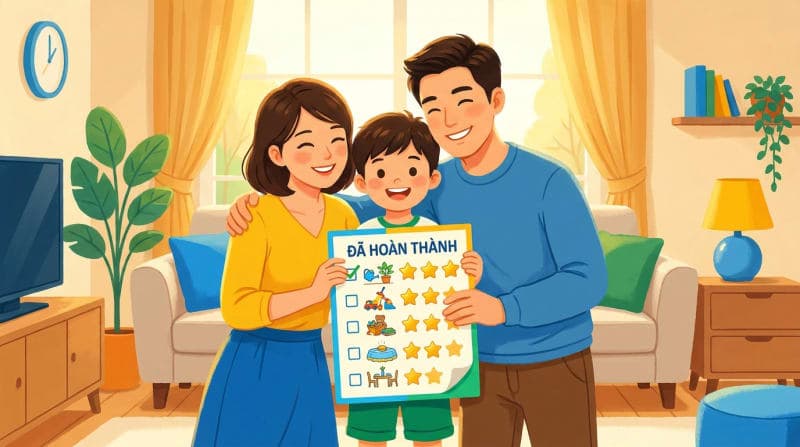
The "THEN" Part (Rewards): Every time a task is completed, the child receives Stars/Reward Points. These stars accumulate to exchange for real gifts they like (going to the park, a new toy, watching a movie...).
Benefits of using the App:
Transparency: The child clearly sees the path to achievement. No more scenes of whining or arguing about whether the child has done it or not.
Continuous Motivation: The feeling of accumulating points and exchanging gifts makes children excited to perform tasks voluntarily without parents needing to remind them.
Habit Formation: Repeating the "Work -> Reward" process on the app helps form positive, long-term discipline habits.
Conclusion
Changing from negative to positive language habits takes time and patience. But with the "When - Then" rule and the support of technology, parents can absolutely teach their children to be well-behaved and self-disciplined without wasting a single shout.
Let your child understand that: Their efforts are always recognized and rewarded worthily. That is the best preparation parents can give for their child's future.
👉 Parents, download Tasky Kid now to start a journey of positive and effortless parenting:https://taskykid.com
🏠 Weekend
🏠 Giao việc nhà cuối tuần sao cho "chuẩn bài" để con vui vẻ hợp tác m