Teaching Kids Self-Motivation: The Secret to Turning Demands into Fun Games (Case Study) | Tasky Kid
📖 StoryWednesday, December 24, 2025|738 просмотров
Teaching Kids Self-Motivation: The Secret to Turning Demands into Fun Games (Case Study)
Are You the Reluctant "Strict Parent" Every Night?
If you are a parent, you have certainly experienced the exhaustion of repeating the same phrase dozens of times every evening: "Tidy up your toys!", "Why haven't you brushed your teeth yet?", "Hurry up, it’s past bedtime!".
The truth is, constant nagging not only leaves you drained but also unintentionally creates a tense atmosphere, turning quality time into an endless power struggle between parents and children. We know that children love to play, but how do we balance fun with building positive habits?
Today, we will share a real-life story from Ms. Lan, a parent in Ho Chi Minh City, who found a solution that completely transformed her family’s atmosphere, turning dry commands into an engaging game. If you are looking for a way to teach your child self-discipline without shouting, this story is for you.
The Bedtime Routine Nightmare: When Procrastination Wins
Ms. Lan is the mother of 7-year-old An. Like many children her age, An is bright and energetic, but also exceptionally skilled in the art of... procrastination.
“In the past, the 'getting ready for bed' routine was a nightly nightmare. She always put off tidying her toys, brushing her teeth, or checking her school bag... I had to repeat myself so many times that I completely lost my patience.”
This isn't just Ms. Lan's problem. Most parents struggle with the transition from a "play" state to an "obligation" state for their children. When parents constantly remind them, children often resist or view the task as the adults' responsibility, not their own. This leads to:
Parental Loss of Patience: Repeating demands makes parents easily frustrated and prone to using negative language.
Reduced Child Autonomy: Children wait for commands instead of initiating actions themselves.
#TaskyKid#NuoiConThongMinh#ViecNha#GiaoDucTichCuc
🌟 Скачать Tasky Kid сейчас
Помогите ребенку выработать хорошие привычки с приложением для управления делами!
Family Tension: The living environment loses its necessary relaxation.
Ms. Lan understood that yelling was not a sustainable solution. She needed a tool to help her child manage personal tasks in a fun and transparent way.
Tasky Kid: Turning Responsibility into a Point-Earning Game
Upon discovering Tasky Kid – the task management application for children – Ms. Lan immediately decided to apply the core principle of positive education: Gamification via a Star Reward System.
Gamification is the process of applying game mechanics (points, levels, rewards) to non-game activities. In Tasky Kid, every completed task is converted into "Stars" ⭐ – a form of currency that children crave.
Ms. Lan’s Specific Task Setup
Ms. Lan set up daily recurring tasks (Daily Chores) with varying levels of challenge:
| Task | Level | Star Reward | Educational Goal |
| :--- | :--- | :--- | :--- |
| Folding clothes independently | Easy | 3 stars | Self-service skills |
| Putting toys in the basket | Easy - Medium | 2 stars | Maintaining cleanliness and order |
| Completing Vietnamese homework | Medium | 5 stars | Focusing on studies |
| Brushing teeth and washing face before 9 PM | Important | 4 stars | Building a bedtime routine |
🚀 The Magic That Happened
The shift from "Mom makes me do this" to "I earn points myself" created a huge change in An’s perception. Tasky Kid is not just a checklist; it's a fair scoreboard that acknowledges her efforts.
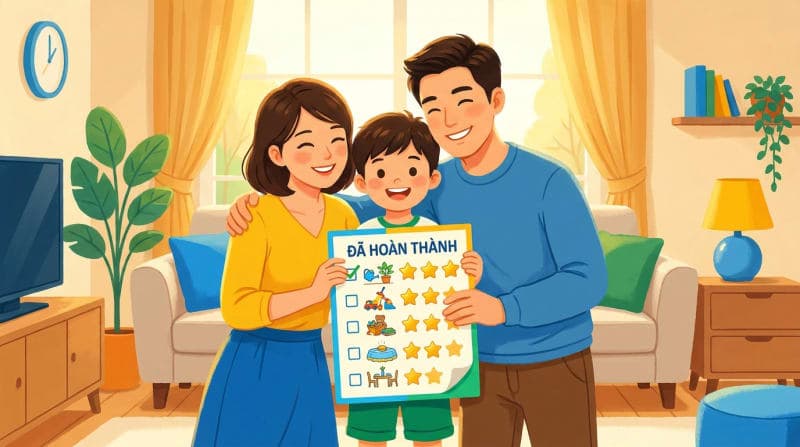
“The miracle is that Tasky Kid turned Mom's dry commands into a point-earning game. An is extremely excited to open the app herself, mark 'Completed,' and watch her Star count ⭐ increase.”
The most significant change was proactiveness. Instead of waiting for her mother to remind her, An checked the app herself to see what she needed to do to achieve her predetermined Star goals.
Furthermore, Tasky Kid allows parents to set clear and appealing reward goals (outings, toys, extra story time...).
“She even proactively asks: 'Mom, what do I need to do today to get enough 50 stars to exchange for the park trip this weekend?'”
This is clear evidence that when children are empowered to own the accumulation process, their intrinsic motivation increases exponentially. Tasky Kid helped An learn the core principle of responsibility: Effort pays off.
Unexpected Benefits Tasky Kid Brings to the Family
Tasky Kid is not just a task management tool; it’s a bridge that fosters connection and reduces family stress.
1. Reducing Stress for Parents
Previously, Ms. Lan had to constantly play the role of the "strict parent." Now, Tasky Kid acts as an objective arbitrator and an unemotional reminder.
Transparency: Rules and rewards are clearly established from the beginning, minimizing arguments about fairness.
Energy Saving: Parents spend energy on praise and encouragement instead of nagging and shouting.
Reinforcing Positive Roles: Ms. Lan can now focus on being a friend and a guide, rather than a strict supervisor.
2. Teaching Essential Management Skills
Children not only learn how to complete tasks but also acquire time management and planning skills from an early age.
Prioritizing Tasks: The child can decide which task to complete first to accumulate stars fastest.
Tracking Progress: Seeing the Star count rise helps the child learn how to monitor long-term goals (like 50 stars for the park trip).
Accountability: By marking "Completed" on the app herself, the child acknowledges her responsibility for that task.
## 3 Golden Rules When Applying the Star Reward System
To maximize the effectiveness of teaching self-discipline with Tasky Kid, parents should keep in mind these three important principles:
1. Set Meaningful Rewards (Not Just Material Goods)
Rewards do not necessarily have to be money or expensive toys. The most meaningful rewards are often quality time or privileges related to experience:
Time: 10 minutes of extra reading time, 30 minutes at the park, watching a favorite cartoon episode.
Privileges: Getting to choose tonight's dinner, deciding the family activity for the weekend, getting to sleep in Mom and Dad’s room.
Goals: Ensure that the goal (e.g., 100 stars) is large and appealing enough to sustain motivation over the long term.
2. Praise Must Be Timely and Specific
When An marks "Completed" for tidying her toys and sees 2 stars immediately appear, that is instant positive feedback. However, parents still need to supplement this with verbal praise:
Instead of: "Good job, honey."
Say: "I saw how you independently folded your clothes neatly. You did that all by yourself without Mom reminding you. These 3 stars you received are absolutely well-deserved for your effort!"
Focusing on effort and initiative (the process) is much more important than just praising the result.
3. Encourage Setting Personal Goals
Let the child participate in deciding tasks and rewards. For example, ask your child: "Do you think tidying your room is worth 5 stars? If you earn 30 stars, what would you like to exchange them for?"
When children are involved, they feel respected and more committed to the system. This is their first lesson in managing goals in life.
Conclusion: End the Nagging War Today
Tasky Kid is not just an application; it is an educational philosophy. It helps parents shift from a controlling role to a guiding role, creating an environment where children learn accountability with enthusiasm and willingness.
As Ms. Lan shared, Tasky Kid not only helped An become more self-reliant but also significantly reduced stress in the family. She no longer has to be the "strict parent" every evening.
If you are tired of constantly reminding your child, it’s time to try Tasky Kid. It is the perfect solution for teaching responsibility in a positive and fun way! 🥳
Start your journey to raising a self-motivated child today:
👉 Discover Tasky Kid and create a star reward system for your child: https://taskykid.com