4 Parenting Styles When Assigning Chores: Which Team Are You On?
The battle of assigning chores to children has never ceased to be a "hot" topic on parenting forums. There are days when a happy family atmosphere suddenly turns tense just because of the classic questions: "Who's washing the dishes?", "Why is your room still such a mess?".
Many parents lament that while the chores are few, the "drama" of reminding, shouting, and even threatening is plentiful. However, how each parent reacts to their child's laziness or negligence varies greatly. This creates interesting educational styles, but also harbors many difficult issues.
So, when facing the "battlefield" in your child's room or a pile of unwashed dishes, which type of parent do you transform into? Let's join Tasky Kid in checking the roll of the 4 common "teams" below to see where you stand and how to "upgrade" your educational methods!
1. Team A: "The Human Megaphone" - Reminding is a passion, volume is a lifestyle
This is probably the most populous group of parents. The identifying characteristic of Team A is persistence... in nagging.
Symptoms: You start with a gentle voice: "Honey, please clean up your toys". 15 minutes later, the volume increases to medium. 30 minutes later, when your child is still glued to the screen, you switch to "fire-breathing" mode, accompanied by the eternal anthems like "How many times have I told you?", "Why do I always have to remind you?".
The Reality: Although you think reminding often will help your child remember, psychological science proves the opposite. Children will form a mechanism of "selective hearing". This means the child learns the rule: "As long as Mom hasn't screamed at max level, I don't need to do it yet".
Consequences: Mom is stressed, has a sore throat, and her blood pressure rises; the child works with a mindset of resistance and fear, not self-discipline. The family atmosphere is always noisy and tense.
2. Team B: "The 'I'll Do It Myself' Parent" - I'll do it for speed, watching you is too painful!
#TaskyKid#DayConTuLap#KhaoSatVui#ParentingHacks
🌟 Скачать Tasky Kid сейчас
Помогите ребенку выработать хорошие привычки с приложением для управления делами!
If Team A leans towards words, Team B leans towards action, but it is... doing the action for the child.
Symptoms: You assign your child to wash dishes, but see them break a bowl, or fail to rinse off the soap. You watch them sweep the floor but the dust remains in the corner. Impatience rises, and you click your tongue: "Just get out of the way, leave it there, I'll do it faster. Watching you makes me tired!".
The Reality: This is the trap of perfectionism. Parents want everything to be clean and tidy immediately and cannot stand the child's clumsiness.
Consequences: The child will become dependent and think: "If I do it badly, Mom will do it for me, so I'll just do a bad job". Gradually, the child loses the opportunity to practice life skills, becoming passive and lacking confidence when having to manage on their own. Parents then take on all the work, feeling both exhausted and resentful because the child doesn't know how to help.
3. Team C: "The Negotiator" - No reward, no work
These are parents who strictly apply market economy principles to child education.
Symptoms: Every task is converted into a benefit. "Clean your room and I'll let you watch TV for 30 minutes", "Wash the dishes and you get ice cream", "Get a 10 (A+) and Dad will give you money".
The Reality: Rewards are good, but if abused, they turn family relationships into commercial transactions.
Consequences: The child will lose intrinsic motivation. They work not out of responsibility to the family or a desire for a clean space, but only for the reward. More dangerously, the child will start to counter-bargain: "If you don't let me use the iPad, I won't take a bath!". When the reward is no longer attractive enough, the child will stop cooperating.
4. Team D: "The Tech 4.0 Parent" - The peak of ease and science
This is the group of modern parents who know how to utilize technology to solve the eternal problem of housework. And this is also the goal that Tasky Kid wants to aim for.
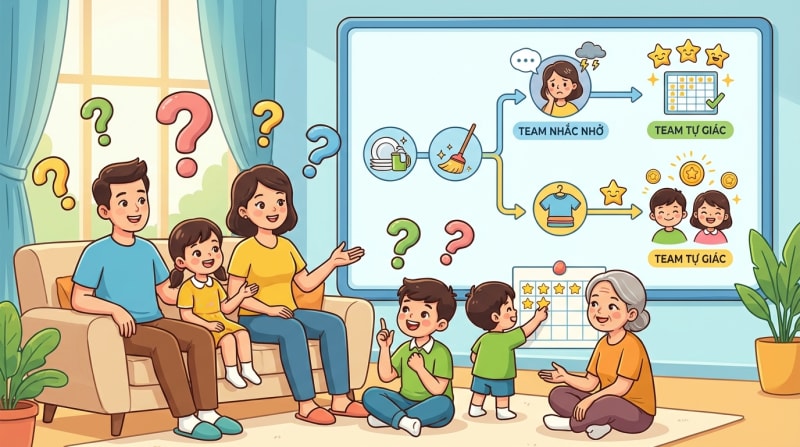
Symptoms: Instead of shouting or doing it for them, parents assign specific tasks on a task management app (like Tasky Kid).
The child has a clear to-do list (with illustrations for little ones).
The system automatically reminds them (replacing Mom's mouth).
Mechanism to accumulate Stars ⭐ to exchange for gifts (creating healthy motivation).
Why is this method effective?
Objective: The app acts as a "referee". The child finishes, checks it off, and parents approve. No more scenes of Mom nagging and the child talking back.
Gamification: Turns boring chores into interesting star-hunting missions. Children love the feeling of leveling up and achieving goals.
Financial and Goal Lessons: The child understands that to get a favorite toy (big reward), they must accumulate stars from small tasks every day. This is a lesson in patience and labor.
How to "upgrade" from Team A, B, C to Team D?
If you find yourself struggling in the first groups, don't worry! Changing habits takes time, but it is entirely possible with the right support.
1. Reset your Mindset
Remember that the goal of assigning chores is not "to have a clean house", but "to make the child independent". Accept that the child may not clean perfectly at first (Team B take note), and patiently guide them instead of doing it for them.
2. Use Support Tools
Don't let yourself play the "villain" shouting all day. Let Tasky Kid be your companion:
Create a Checklist: List age-appropriate tasks (3 years old puts away toys, 6 years old folds clothes, 10 years old washes dishes...).
Agree on Reward Rules: Discuss with your child how many stars are needed to exchange for a trip to the park or a new comic book. This helps the child feel respected (Team C upgraded version).
3. Recognition and Encouragement
When your child completes a task on the App, don't forget to give them a real compliment or a hug. Technology helps manage, but parents' love is the biggest motivation for children to maintain good habits.
Conclusion
Raising children is a long journey full of challenges but also filled with joy. Instead of letting housework become an emotional barrier, turn it into an opportunity for your child to mature and for the family to bond.
No matter which "team" you belong to, switching to a modern, more scientific educational method is always a wise decision. Let Tasky Kid help parents unload the burden of "reminding", so that every day coming home is a happy day, where children are self-disciplined and parents are relaxed.
👉 Are you ready to join Team "Tech 4.0"? Download Tasky Kid now and experience the interesting method of teaching children independence at:https://taskykid.com
🏠 Weekend
🏠 Giao việc nhà cuối tuần sao cho "chuẩn bài" để con vui vẻ hợp tác m
📅 Sunday, May 24, 2026
4 Parenting Styles When Assigning Chores: Which Team Are You On? | Tasky Kid