The Secret to Teaching Kids to Clean: When the Definition of "Tidy" Gets Lost in Translation
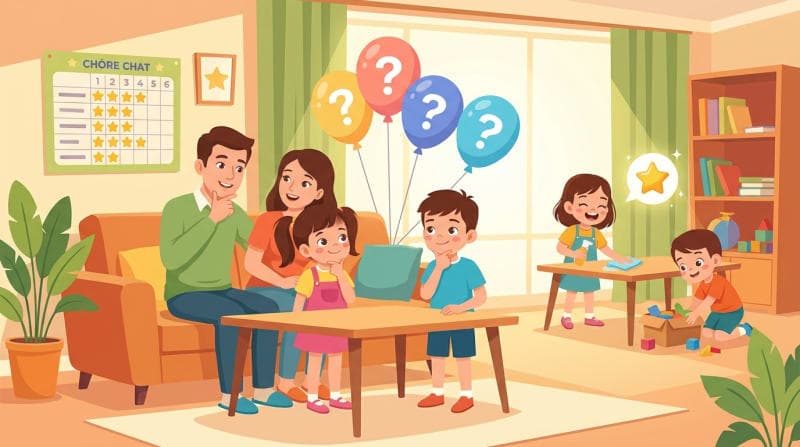
Do you ever feel that you and your children, despite living under the same roof and speaking the same language, are actually using two completely different "dictionaries"? This language barrier is most evident in a seemingly simple phrase: "Tidy up your room."
You walk into your child's room after they declare, "I'm done!", and it looks decent at first glance. But the moment you accidentally open the closet door... "KA-BOOM!", a rain of toys, books, and balled-up clothes comes crashing down like a waterfall.
Welcome, parents, to the conflicting "Universe of Order" between adults and children. Let's join Tasky Kid in decoding this phenomenon and finding a solution so your child's room is actually clean, not just "visually passable."
1. The Clash of Definitions: "Tidy" in Mom's Eyes vs. Kid's Eyes
To solve the problem, we first need to understand the source of this "misalignment." Why does the same command yield results so far from expectations?
Mom's Definition (5-Star Standard)
For adults, especially moms, "tidy" is a comprehensive state that includes:
Location: "A place for everything and everything in its place."
Hygiene: The floor isn't just empty; it must be dust-free.
Aesthetics: Pillows must be square, books arranged by height, clothes folded neatly.
Detail: No trash under the bed, no candy wrappers in the desk drawers.
Kid's Definition (Survival Standard)
Conversely, with a child's simple and visual mindset, "tidy" is often defined by... The Trail Theory:
Clear Passage: As long as there is a small path wide enough to walk from the door to the bed without stepping on a Lego spike, it meets the standard.
#TaskyKid#NuoiConThongMinh#HaiHuoc#ViecNha
🌟 Baixe o Tasky Kid Agora
Ajude seu filho a construir bons hábitos com um aplicativo de gerenciamento de tarefas!
Out of Sight: The rest doesn't need to disappear; it just needs to be invisible.
Speed: How to get back to gaming or watching TV as fast as possible.
2. The "Ninja Techniques" Kids Use to Clean
When a child's standard is "fast and loose," they often maximize their creativity to cope with their parents' demands. Here are the 3 most common techniques that every parent has likely sighed at:
Technique 1: The Art of Invisibility Under the Bed
This is the world's largest secret storage facility. From a lonely sock and a half-read comic book to an empty milk carton... everything is gently "kicked" under the bed. As long as the bedsheet is long enough to cover the darkness beneath, the room is considered clean.
Technique 2: The Stuffing Strike
Closets and desk drawers are the next victims. Instead of folding or stacking, children apply the principle of air compression: just stuff everything in and close the door immediately before it bursts out. This is the cause of those "avalanches" of belongings when Mom checks.
Technique 3: The Camouflage Blanket
What if the bed is too messy? Simple, throw a blanket over the whole mess. From a distance, the bed looks flat and cozy, but beneath that layer is a chaotic "ecosystem" of toys.
3. Why Do Children "Clean" Just to Get By?
Don't be too quick to accuse your child of being lazy or deceitful. According to developmental psychology, young children's thinking is very concrete.
When parents give an abstract command like: "Tidy up your room so it's neat," the child's brain gets overloaded. They don't know where to start, how to satisfy Mom, or when it constitutes being "done." The feeling of being overwhelmed leads them to choose the quickest shortcut to escape this difficult task.
Furthermore, children haven't formed the habit of organization and arrangement without detailed, step-by-step guidance.
4. The Tasky Kid Solution: Divide and Conquer the Mess
Instead of playing Sherlock Holmes every day to find lost items or getting angry and yelling, try changing how you assign tasks. The secret lies in SPECIFICITY and ENCOURAGEMENT.
Transform the abstract concept of "tidy" into small, clear actions with attached rewards on the Tasky Kid app.
Step 1: Convert actions into Star rewards ⭐
Don't assign vague chores. Create a housework list on the app with detailed tasks:
Put Lego in the plastic bin: 2 stars ⭐ (Instead of saying "Clean up toys").
Hang backpack on the hook behind the door: 1 star ⭐ (Instead of saying "Put your bag away").
Fold the blanket neatly: 3 stars ⭐ (Instead of saying "Make the bed").
Sort dirty clothes into the basket: 2 stars ⭐.
Arrange books on the shelf: 2 stars ⭐.
Step 2: Set acceptance standards
On Tasky Kid, parents can require their children to take a photo of the result to have their stars approved. This forces the child to actually do the work rather than "hiding" items. For example: "Take a photo of the organized desk drawer to receive 5 stars."
Step 3: Exchange stars for gifts
When the goal is clear and the reward is attractive (like exchanging stars for TV time, a trip to the bookstore, or a favorite toy), the child's motivation changes. From a mindset of "finish just to avoid scolding," they switch to "do a great job to earn more stars."
5. Conclusion
The difference in the definition of "tidy" between parents and children is completely normal during a child's growth. Instead of conflict, turn cleaning into an exciting game with clear rules and worthy rewards.
When your child clearly understands that "Tidy means books on the shelf, clothes in the closet, toys in the bin," and receives positive recognition from parents through sparkling stars on Tasky Kid, their "quality standards" will surely increase significantly.
Parents, are you ready to help your child redefine tidiness?
👉 Download Tasky Kid now to start the journey of building tidy habits for your child:https://taskykid.com
🏠 Weekend
🏠 Giao việc nhà cuối tuần sao cho "chuẩn bài" để con vui vẻ hợp tác m
📅 Sunday, May 24, 2026
The Secret to Teaching Kids to Clean: When the Definition of "Tidy" Gets Lost in Translation | Tasky Kid