The Power of Repetition: The Golden Key to Raising Independent Children
Have you ever found yourself in this scenario: Every night, your child insists you read the exact same fairy tale, even though they have memorized every single detail? Or perhaps they watch the same cartoon episode over and over for a whole week, yet still laugh out loud as if it were the first time?
Sometimes, this repetition can feel boring and baffling to us adults. We often ask ourselves: "Why doesn't he want to explore something new?"
But parents, please don't worry. In a child's world, repetition is not a sign of passivity. On the contrary, it is a crucially important mechanism of developmental psychology, serving as the foundation for a child to build intellect and emotion. Even better, if you know how to leverage this mechanism, you hold in your hands the "golden key" to instilling independence and discipline in your child without the need for shouting or punishment.
Let's join Tasky Kid in decoding this brain mystery and see how to apply it to parenting!
1. Why is a child's brain "addicted" to repetition?
To understand our children, we need to view the world through their lens. To a child, the vast world out there is full of new, chaotic, and sometimes scary things.
The need for safety and order
Children always crave a sense of safety. When they know what will happen next (in a story, in a movie), their brains release relaxing hormones. Repetition brings a sense of control and order. The child feels confident because they correctly "predicted" the outcome, thereby building trust in themselves and their surrounding environment.
Strengthening Neural Connections
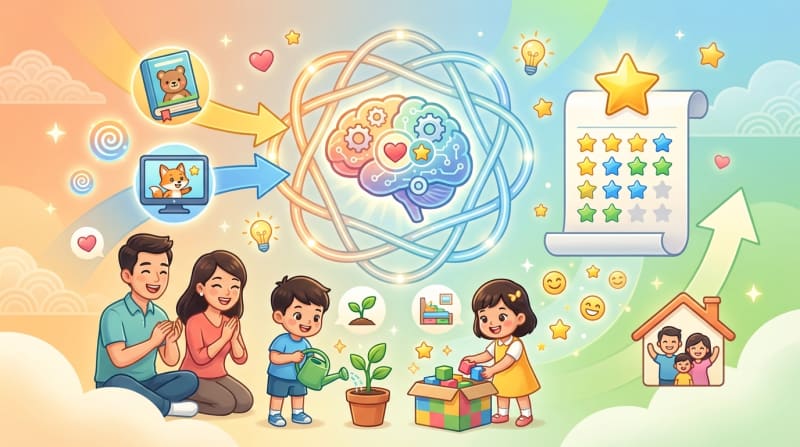
Biologically, every time a child repeats an action, the connections between nerve cells (neurons) are strengthened. Imagine the brain as a dense forest. The first time you walk through, the path is very faint and difficult to traverse. But if the child walks that path every day, the grass wears down, forming a clear, beaten path that is much easier to walk on.
Repetition helps turn new, difficult skills into something fluent and automatic. This is how children learn to speak, learn to walk, and of course, learn to do chores.
2. "The Power of Habit": From Science to Educational Reality
Applying the "beaten path" principle of the brain to education, we see that the key to getting children to do tasks obediently is not big rewards or heavy punishments, but rather consistency and repetition.
Turning action into a natural reflex
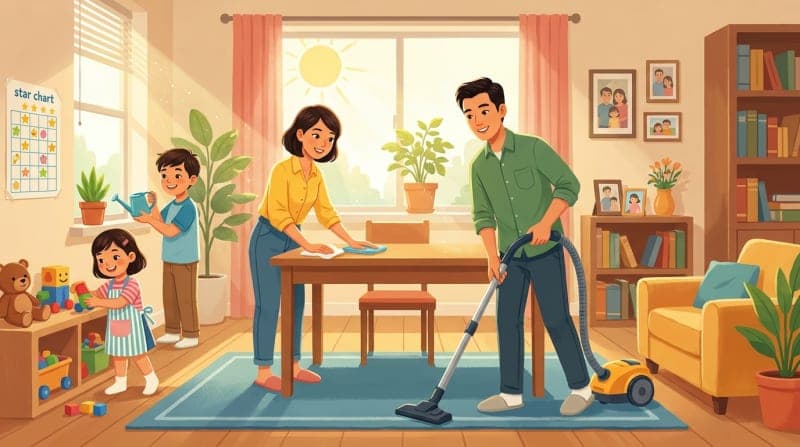
When a task like cleaning up toys after playing, or packing school bags in the evening is done regularly at a fixed time, the child's brain will gradually form an automated mechanism.
Initially, cleaning up might cause resistance because the brain views it as "hard work." But after 21 to 60 days of continuous repetition, that action shifts from the prefrontal cortex (where logical thinking occurs, consuming a lot of energy) to the basal ganglia (where habits are processed, consuming little energy).
At this point, the child will work based on natural reflex. When that time comes, their hands and feet will automatically want to clean up without much internal struggle.
Minimizing family conflict
The biggest benefit of establishing habits based on repetition is eliminating the "nagging." When housework becomes part of the biological rhythm (like brushing teeth or going to bed), parents don't need to play the "police officer" reminding and scolding.
No more scenes of: "How many times have I told you?" or "Why haven't you done your homework?". Instead, the established process guides the child's behavior.
3. How to build effective repetitive habits for children
However, theory is one thing, but practice is far from simple. Busy lives make parents sometimes forget to remind their kids, or easily let things slide for a few days. This lack of consistency is the number one enemy of habit formation.
Here are steps for parents to leverage the power of repetition:
- Set a fixed timeframe: "A time for everything" is the golden rule. For example: 7:00 PM is for cleaning up toys, 8:00 PM is for packing books.
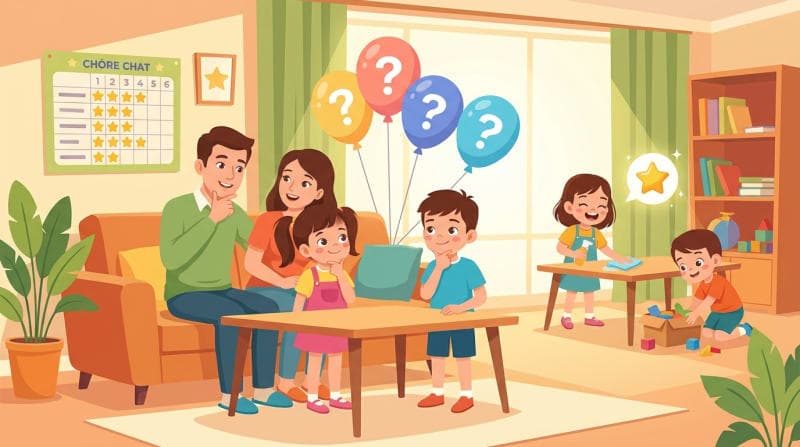
- Visualize the work: Children think in images better than words. A Chore Chart stuck on the fridge is a classic but effective method.
- Persist for at least 4 weeks: Don't give up if your child isn't self-disciplined in the first week. Remember the "beaten path"—the grass can't be worn down after just a few steps.
4. Tasky Kid - The powerful assistant helping parents maintain repetition
Understanding the mechanism of the child's brain and the struggle parents face in maintaining consistency, Tasky Kid has developed specialized features to solve this problem.
"Recurring Tasks" Feature
Instead of parents having to recreate a to-do list every day, Tasky Kid allows setting up tasks that repeat daily or weekly.
- Example: Parents only need to set "Clean up toys" to repeat at 19:00 daily.
- Right on time, the app sends a gentle reminder notification to the child's (or parent's) device. This helps the child understand: "This is the rule, not Mom being difficult."
Turning boring repetition into fun
Children like repetition, but they also like excitement. Tasky Kid incorporates Gamification elements. Every time a recurring task is completed, the child not only receives praise but also accumulates reward points, stars, or badges.
Seeing their completion streak grow longer each day stimulates the child's brain to release Dopamine (the happiness hormone), making them excited to maintain that habit chain and unwilling to break it.
Visual Progress Reports
Tasky Kid provides habit tracking charts, helping both parents and children see clear progress. When children see how hard they have worked over the past month, their self-esteem and confidence increase significantly.
Conclusion
Repetition is not boredom; it is the foundation of safety, the way a child's brain learns and matures. Parents, be patient, turn small daily actions into joyful rituals, helping your child build a disciplined lifestyle from within.
Don't let reminding your child become a daily burden. Let technology support you in the smartest way possible.
👉 Start building an independent lifestyle and positive habits for your child today with Tasky Kid at: https://taskykid.com
Let Tasky Kid accompany parents on the journey of raising children that is wise, stress-free, and full of laughter!
🌟 Baixe o Tasky Kid Agora
Ajude seu filho a construir bons hábitos com um aplicativo de gerenciamento de tarefas!
Baixar Grátis