Teaching Kids About Money: Turning Chores Into Their First Financial Lessons | Tasky Kid
💡 TipsThursday, January 01, 2026|802 visualizações
Teaching Kids About Money: Turning Chores Into Their First Financial Lessons
"Mom, buy me that Lego set!", "Dad, I want a new bike!"...
Perhaps every parent has faced this awkward situation at least once: Standing in the middle of a supermarket or toy store, facing the pleading eyes (or even a full-blown tantrum) of their child. In these moments, parents usually react in two common ways: One is to reluctantly pull out their wallet just to end the scene, and the other is to flatly refuse and deliver a long lecture about how "we don't have money" or "you already have too many toys."
However, neither approach is truly optimal for developing a child's mindset. Instead of simply saying "Yes" or "No," why don't parents turn this situation into a golden opportunity to teach their child about finance and the value of labor?
Try a fresher approach: "This toy is worth 50 stars. Do you want to make a plan with Mom to earn enough stars for it?"
This is when we apply the "Token Economy" model right at home, turning boring daily chores into invaluable first lessons in finance.
1. The "Token Economy" - When Chores Are Not Just Obligations
In the adult world, we go to work, receive a salary, and use that money to buy what we need. For children, the concept of "money" is quite abstract. Therefore, "stars," "reward points," or "coupons" are the most suitable currency for their age group.
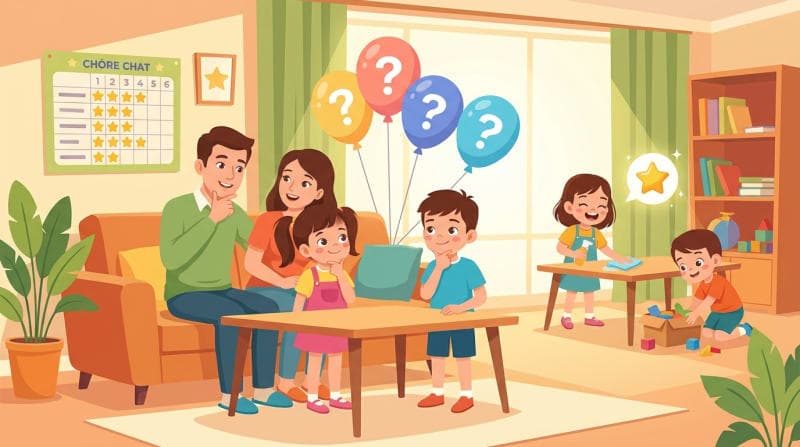
Setting up a chores-for-stars exchange system (on paper or via an app like Tasky Kid) helps children clearly visualize the operating process of a miniature economy:
Labor (Chores) = Income (Stars/Reward Points).
Accumulated Income = Rewards (Toys/Books/TV Time).
When applying this method, parents not only help children form the habit of doing chores voluntarily but also plant the seeds of important financial mindsets.
Children today are often overprotected, leading to a sense of "Entitlement." They think that having good food, nice clothes, and new toys are obvious things that parents must provide.
When parents say: "To get this toy set, you need 50 stars. Every time you sweep the house clean, you get 2 stars; folding clothes neatly gets you 3 stars", the child will immediately realize a truth: Rewards do not appear out of nowhere.
Through Tasky Kid, every time a task is completed (sweeping, wiping the table, watering plants...), the child receives immediate recognition via added stars. This process helps them understand that:
Money (or toys) is the result of sweat and effort.
To get high-value items, they must put in corresponding effort.
Laziness will yield no results (no work = no stars).
When they "earn" the toy they like with their own labor over a week or a month, they will cherish and take care of it much more than gifts given for free.
3. Lesson #2: Skills in Accumulation, Saving, and Patience
One of the most important financial skills that even adults struggle with is Delayed Gratification.
Children often want everything "right now." But with the star exchange system, they are forced to learn how to wait and accumulate.
If the child wants to exchange 10 stars for an ice cream today? Fine, but it will take longer to reach the goal of 50 stars for the big toy set.
If the child patiently "skips" the ice cream and works hard for 3 more days, they will have enough stars to exchange for their dream gift.
This is an introductory lesson on Saving and Budgeting. Children learn to set long-term goals and break them down into specific daily actions. Instead of demanding things instantly, they learn to patiently gather every single star each day to exchange for a bigger goal.
4. What Do Parents Need to Do to Set Up an Effective "Star Bank"?
To make this method a reality, parents need clarity and consistency. Here are suggested steps to apply it with Tasky Kid:
Step 1: Agree on the "Task Price List"
Sit down with your child and list household chores suitable for their age. Assign a specific number of stars to each task based on difficulty.
Example: Tidying up their own toys (1 star), Wiping the dining table (2 stars), Sorting trash (3 stars), Washing dishes (5 stars).
Note: Distinguish between personal tasks (brushing teeth, bathing - which are mandatory responsibilities, no stars paid) and family chores (housework - stars paid).
Step 2: Price the rewards
Identify the gifts or privileges the child wants and convert them into stars.
Example: Watching TV for 30 minutes (10 stars), Going to the water park (100 stars), Buying a comic book set (200 stars).
Let the child decide the goal they want to aim for.
Step 3: Use visual tracking tools
Children love visuals. Seeing their star count increase every day on the Tasky Kid app will create a sense of achievement (Dopamine), motivating them to keep trying. The app helps parents avoid forgetting to add points, and the child can check their "account" at any time.
Step 4: Seriously honor the commitment
When the child has accumulated enough stars, parents should fulfill the promise to exchange the gift immediately. This builds trust and reinforces the connection between "effort" and "reward." Conversely, if the child doesn't have enough stars, absolutely do not "advance" credit or buy the gift just because they are crying.
Conclusion
Teaching children about money doesn't mean turning everything in the house into a commercial transaction, but rather teaching them about responsibility, the value of labor, and the mindset of managing personal desires.
A child who knows how to sweep the floor to earn stars today will be an adult who knows how to work hard and manage finances smartly in the future. Let Tasky Kid accompany parents in setting up a "star bank" for your little one today, turning boring chores into an exciting learning journey!
👉 Are parents ready to experience this with your child? Download the app now at: https://taskykid.com
🏠 Weekend
🏠 Giao việc nhà cuối tuần sao cho "chuẩn bài" để con vui vẻ hợp tác m