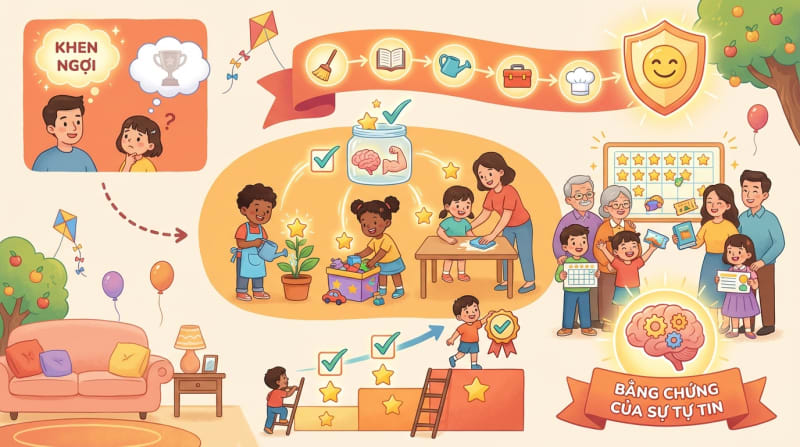
The Secret to Confident Kids: Don't Just Praise, Create "Evidence"
On the journey of parenting, have you ever asked yourself: "Why do I always praise and encourage my child every day, yet when faced with a difficult math problem or a new environment, they remain timid and lack confidence?"
This is a paradox that gives many parents a headache. We are often advised that praise is "food" for a child's soul, helping them build self-esteem. However, modern psychology has pointed out an interesting and somewhat counter-intuitive truth: Sustainable confidence does not come from external praise, but from internal specific "evidence" of action.
So how can we help children build this repository of "evidence"? Let's dive deep into the nature of true confidence with Tasky Kid.
1. Empty praise and the trap of dependency
When we constantly tell children things like "You're so good", "You're so smart", we have good intentions. But if that praise isn't attached to a specific effort or result, it can cause side effects.
Children are very perceptive. If a child draws a scribbled picture and their parents call it a "masterpiece," the child's brain registers a contradiction. Over time, children may become suspicious of adult praise or, worse, develop a fear of failure—they won't dare to try new things for fear of no longer being praised as "good" or "smart."
Confidence built on praise is like a sandcastle: very beautiful, but easily collapsed when the waves crash in.
2. Self-Efficacy: The Golden Key to Confidence
Professor Albert Bandura, the father of Social Cognitive Theory, introduced the concept of Self-Efficacy (Belief in one's own capacity). This is the very core of confidence.
Self-Efficacy is not the feeling of "I'm wonderful," but the firm belief that "I have the ability to solve this problem" or "I can complete that task."
This belief cannot be "planted" in a child's head through words. It must be proven. A child's brain needs to see tangible evidence that their body and mind can impact the world around them and produce results.

3. Chores: The daily factory for "evidence" of capability
Many parents are hesitant to let their children do housework because they fear their child will get tired, break things, or simply want them to focus on studying. However, housework is the greatest, safest, and cheapest environment for children to accumulate a "capital" of confidence.
Why is that?
- Completion: When a child folds their blanket neatly by themselves in the morning, that is a completed mission.
- Instant Feedback: When a child washes a bowl, the bowl goes from dirty to clean. That is a visual result they can see immediately.
- Mastery: The first time they sweep the floor, it might still be dusty, but by the 10th time, it will be cleaner. They recognize their own progress.
Every time a small task is completed, the child's brain releases Dopamine (the happiness hormone) and records a crucial signal: "I did it."
It is these small, repeated daily successes that form the solid foundation helping children not to shy away when facing bigger challenges at school or in life. A child who knows how to cook a simple meal on their own will be less panicked when solving a difficult math problem, because they already possess a belief in their ability to figure things out.
4. How parents can help children accumulate "evidence"
To turn chores into an educational tool rather than a burden, parents should try applying the following process:
Assign age-appropriate tasks
Don't force children to do tasks that are too overwhelming and discouraging, but also don't assign tasks that are too easy and boring.
- 3-5 years old: Put away toys, put dirty clothes in the hamper.
- 6-9 years old: Fold blankets, wash dishes, water plants.
- 10+ years old: Cook simple meals, clean their own room, manage allowance.
Focus on the process, not perfection
Don't criticize if the blanket isn't folded perfectly straight. Acknowledge it: "I see you tried very hard to smooth out the corners of the blanket; it looks much neater than yesterday." This is how parents confirm the "evidence" of their child's effort.
Visualizing Success
Children think very visually. Praise flies away with the wind, but an achievement chart remains. This is where technology can effectively support parents.
5. Tasky Kid: Turning effort into tangible "evidence"
Understanding the psychology of Self-Efficacy, the development team at Tasky Kid designed a system not just to "assign tasks," but to "acknowledge capability."
The star ⭐ reward system on the Tasky Kid app plays a role more important than just a prize:
- It is a scorecard of effort: Each star is a milestone confirming the child has completed a mission.
- It is a history of perseverance: When a child looks back at a star-filled achievement board from last week or last month, they clearly see: "Wow, I did all of that?". That is solid evidence of hard work and capability.
- Intrinsic motivation: The feeling of watching the star count increase every day stimulates excitement and the desire to conquer the next challenge.
Conclusion
Confidence is not a gift parents can hand to their children; it is a reward children must earn for themselves through action.
Instead of just speaking hollow words of praise, hand your child a broom, a bowl, or the responsibility of tidying their study corner. Let them experience the feeling of "I can do it." And don't forget to let Tasky Kid accompany you in recording those wonderful "evidences" of growth.
Start helping your child build confidence from the smallest tasks today!
👉 Download the Tasky Kid app to start the journey of building confidence with your child: https://taskykid.com
🌟 Obtenez Tasky Kid Maintenant
Aidez votre enfant à prendre de bonnes habitudes avec une application de gestion des tâches pour enfants !
Télécharger Gratuitement