Empower Your Child: The Secret to Self-Discipline and Stress-Free Parenting
Have you ever felt like your home turns into a "battlefield" every morning? The rushing to brush teeth, the reminders to pack schoolbags, and finally the shouting when your child is still dawdling? Paradoxically, the stricter your orders, the more children tend to resist, become stubborn, or just do the bare minimum.
Why do our well-intentioned reminders backfire? The answer lies deep within behavioral psychology that not all parents are aware of. This article reveals the secret of "Autonomy" and how to transform a passive child into an excellent "manager" of their own life.
1. Why do "Royal Decrees" lose to... child psychology?
In developmental psychology, the need for Autonomy is one of the three basic psychological needs of humans (alongside Competence and Relatedness). From the moment they take their first steps, children crave control over the world around them. That is why a 3-year-old often says "No!" or demands, "I do it myself!".
When parents continuously act like a "loudspeaker," issuing a series of commands like: "Go shower now!", "Do your homework!", "Clean up your toys quickly!", the child's brain activates a defense mechanism.
- Loss of control: Children feel like puppets, with every action controlled by adults.
- Resistance mindset: To regain a sense of control, children choose to resist (argue back) or resist passively (dawdle, pretend not to hear).
- Loss of intrinsic motivation: Children work only to avoid being scolded, not because they understand it is their responsibility.
2. The "Empower the Boss" Strategy - A Turning Point in Parenting
The secret to resolving this tension isn't finding harsher punishments, but changing the approach: Empower your child to be the "Boss" of their own tasks.
Imagine if, at work, your boss stood behind you every 5 minutes reminding you of every little detail; wouldn't you feel annoyed? Children are the same. Instead of micromanaging, switch to the role of a "Senior Advisor."

When empowered, children receive the message: "Mom and Dad trust that you can do it." This trust is the most powerful catalyst for stimulating self-discipline.
3. Applying technology to empower subtly
In the digital age, empowerment doesn't mean negligent management. Parents need a tool for children to practice autonomy within a safe framework. This is where Tasky Kid comes into play as a powerful "virtual assistant."
Instead of verbal reminders (which easily cause frustration), let your child interact with the app. Here is how Tasky Kid helps parents apply behavioral psychology in reality:
Empowering Proactivity: "What do I need to do today?"
Instead of waiting for Mom's orders, the child will open Tasky Kid themselves to view the day's task list. This action, though small, has significant meaning: It shifts the child's state from Passive (Waiting for orders) to Active (Grasping information). They will know that at 7 AM they need to do personal hygiene, and at 8 PM they need to study, without the sound of Mom's loudspeaker.
Creating a Sense of Achievement: "I finished it!"
The feeling of manually ticking the "Completed" box on the app brings dopamine-fueled satisfaction (the happiness hormone). It is instant recognition for the child's effort. Children will work more enthusiastically to enjoy the feeling of "crossing off" finished items, rather than working with a frowning face.
Learning Asset Management: "My Star Fund"
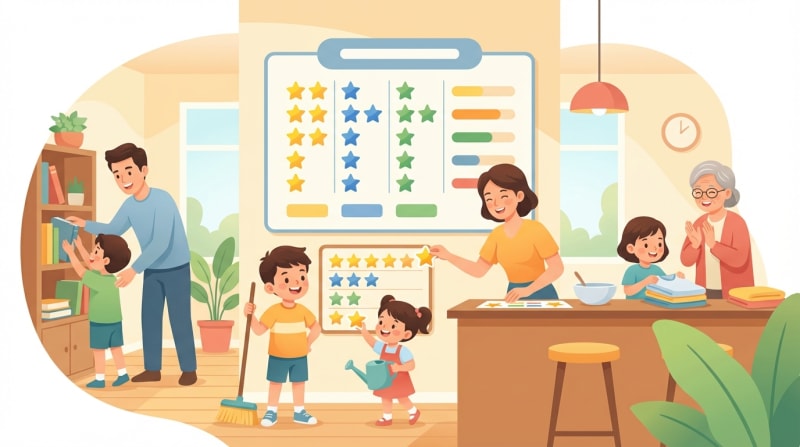
Tasky Kid is not just a to-do list, but also an early financial lesson. When completing tasks, the child receives reward stars.
- The child has the right to decide: Accumulate stars to exchange for a big gift (bicycle, Lego set) or exchange immediately for a small treat (watching TV, eating ice cream).
- This decision-making power helps children learn lessons about patience, trade-offs, and taking responsibility for their "assets."
4. Small secrets to help parents "wean off" the nagging habit
Besides using Tasky Kid, parents can combine the following communication techniques to optimize effectiveness:
- Offer choices: Instead of "Go take a shower," ask "Do you want to shower right now or in 10 minutes?". The child still has to shower, but they get to choose the time (Sense of Autonomy).
- Ask questions instead of ordering: Instead of "Pack your books," ask "How is your preparation plan for tomorrow going?".
- Be patient with mistakes: When empowered, sometimes children will forget or make mistakes. Don't rush to scold or do it for them. Let the child face natural consequences (e.g., forgetting a hat leads to being hot in the sun) so they can learn from experience.
Conclusion
Parenting is a long journey where the ultimate goal is not to create children who obey blindly, but independent, autonomous, and responsible individuals.
Empowering your child as the "boss" through the Tasky Kid app not only helps parents free themselves from endless battles but also builds a solid foundation of life skills for the child. When children feel respected and in control, they will perform every task with joy and pride.
👉 Are parents ready to step back so your child can step forward? Download the app now and start the journey of empowering your child's self-discipline at: https://taskykid.com