The Secret to iPad Detox: Don't Ban It, Teach Your Child to "Pay" for It!
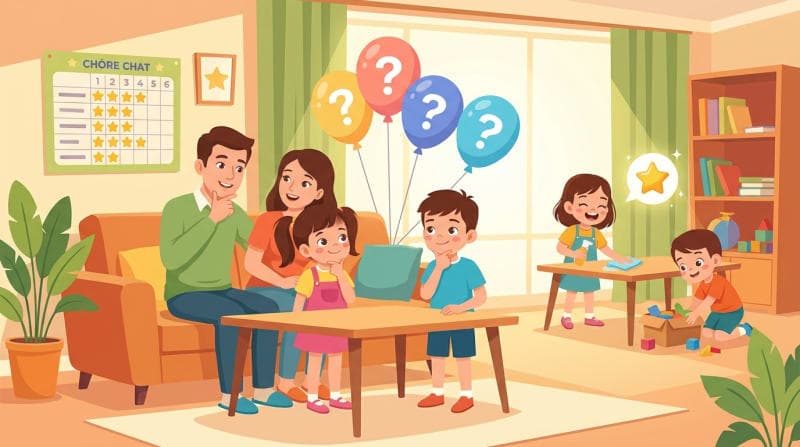
Are you stuck in an "endless battle" called: My child demands the phone?
Every afternoon when you come home from work, instead of a cheerful greeting, are you met with a sulky face because the iPad was confiscated? Or perhaps a scene of your child crying and throwing a tantrum on the floor just because mom turned off the TV at the most exciting part?
This isn't just one family's story. In the digital age, controlling children's screen time is a common "headache" for millions of parents. However, instead of playing the "villain" who constantly bans everything, a mother in Hanoi has found an incredibly smart solution: Turning the iPad from an "enemy" into an educational "tool".
Let's explore the spectacular transformation journey of Ms. Thu Hoai and little Ken (7 years old) to see where the secret lies!
1. When home becomes a "battlefield" over a tiny screen
Ms. Thu Hoai (Hanoi) once shared her feelings of helplessness in a parenting group. She recounted: "Before, the atmosphere in the house was always as tense as a violin string. As soon as Ken saw me come home, he would rush out not to hug me, but to ask: 'Mom, where's the phone?'. If I didn't give it to him, he would sulk, cry loudly, and refuse to eat. But if I softened and let him watch, inevitably, he would sit there for hours, eyes glued to the screen, refusing to bathe or clean up his toys."
Hoai admitted that there were times she chose the solution of... hiding the iPad away, or setting a difficult password. But the consequence was that her child became irritable, sneaking around to watch secretly, or whining until mom went crazy.
This is a mistake many parents make: The more you forbid, the more the child craves. Depriving a child of entertainment devices without offering a roadmap or a convincing reason only makes them feel imposed upon and breeds a rebellious mentality.
2. Changing Mindset: From "Banning" to "Exchanging"
After many days of worrying and consulting modern educational methods, Hoai realized that: The problem is not the iPad, but how the child approaches it. If the child considers watching TV a "natural right," they won't appreciate it. But if it is a "reward," things will be different.
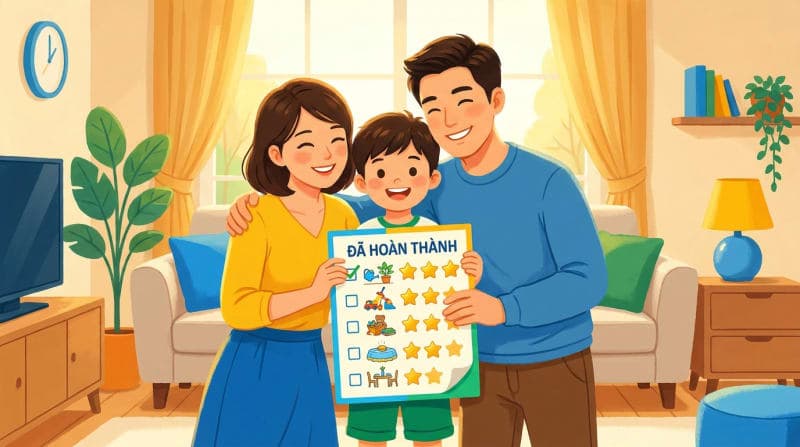
Determined to change, Hoai applied the Tasky Kid app to set up a new management system for the family. She jokingly calls it the "Good Deeds Exchange."
Instead of saying "No watching!", Hoai says: "You can absolutely watch, if you have enough 'budget' to pay for that time."
3. Setting up a transparent "Exchange Rate Table" – The Secret to Success
On the Tasky Kid app, Hoai and Ken sat down together and agreed on a very clear "exchange rate table." Every chore and good habit is converted into Stars (the reward unit in the app).
Here is the actual "price list" that Ken is applying:
- Tidying up toys neatly after playing: +5 stars ⭐
- Going to take a shower on time (before 6:30 PM): +5 stars ⭐
- Folding the blanket after waking up: +5 stars ⭐
- Eating all the vegetables at dinner: +10 stars ⭐ (Since Ken is very lazy about eating veggies, the "price" for this is significantly higher).
- Finishing homework before 8:00 PM: +15 stars ⭐
And the most important part, where Ken "spends" the stars he earned – The Redemption Store:
- Buy a small toy: 200 stars
- Go to the bookstore on the weekend: 300 stars
- 30 minutes of cartoons/gaming: 50 stars 📺
4. Surprising Results: When the child watches TV in the posture of a "Winner"
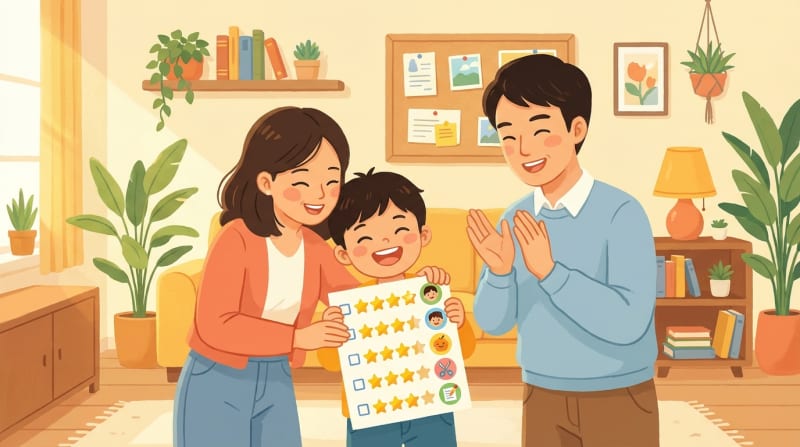
The change happened almost immediately. "Unexpectedly, instead of whining, Ken started rushing to find work to do," Hoai shared with a laugh.
Now, whenever he wants to watch cartoons, Ken no longer cries or demands. The boy opens the Tasky Kid app himself to check how many stars he has. If he doesn't have enough 50 stars? Ken will voluntarily go fold clothes, tidy up the bookshelf, or ask mom if there are any extra chores.
Hoai confided with relief: "Now, when he turns on the TV, he watches in the posture of a 'winner,' someone who has worked to achieve a result. He is happy and confident, and mom no longer needs to play the bad guy confiscating the device. When time is up, he turns it off voluntarily because he knows the 'budget' has run out."
5. Why is this method effective?
From a psychological and educational perspective, the method Hoai applied via Tasky Kid brings more benefits than simply "managing the child":
- Teaching the child the value of labor: The child understands that "there is no such thing as a free lunch." To get entertainment, they must trade it for effort.
- Training basic financial thinking: The child learns how to earn, save, and spend reasonably. They will have to calculate: "Should I use 50 stars to watch TV right now, or save 300 stars to buy a Lego set this weekend?".
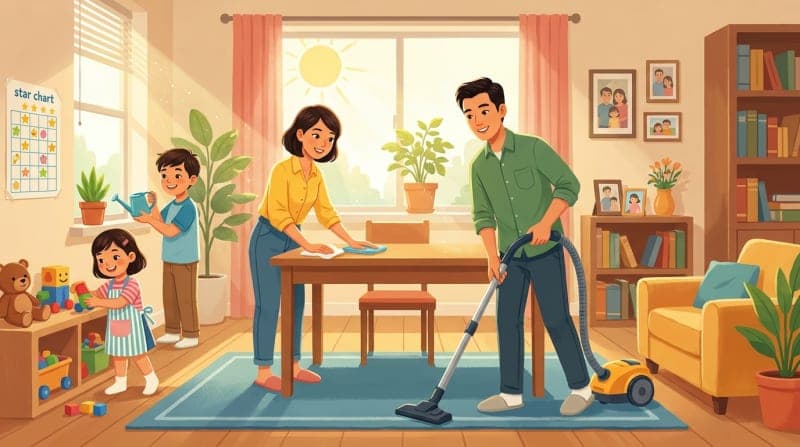
- Developing planning skills: The child arranges their own time to complete tasks to achieve goals.
- Building self-discipline: Motivation comes from within (the desire to watch TV/receive gifts), which is much more sustainable than external pressure (scolding from parents).
6. Advice for parents when starting out
To successfully apply this model like Ms. Hoai, parents need to note:
- Transparency and Fairness: The "exchange rate" needs to be agreed upon from the start. Don't arbitrarily change the star count while the child is performing the task.
- Don't Inflate: Don't let tasks be too easy to earn too many stars; this will devalue the rewards.
- Patience: In the early days, the child may not be used to it or may object. Be patient in explaining and implement it strictly on the app.
- Use Support Tools: Writing on paper is easy to forget or lose. Using an app like Tasky Kid makes adding/subtracting stars fun, visual, and accurate, making children more excited (like playing a game to level up).
CONCLUSION
Parents, as you can see, the iPad or phone isn't bad; what's bad is that we don't have the right management method yet. Instead of extreme banning that causes family tension, turn your child's desires into motivation to practice good habits!
Let your child work and "earn" their entertainment privileges gloriously. That is the sustainable way of education that helps children grow up independent.
👉 Are parents ready to "reset the order" for their family? Download Tasky Kid now and create the first "exchange rate table" for your child at: https://taskykid.com