The Power of Repetition: The Golden Key to Raising Independent Children
Have you ever found yourself in this scenario: Every night, your child insists you read the exact same fairy tale, even though they have memorized every single detail? Or perhaps they watch the same cartoon episode over and over for a whole week, yet still laugh out loud as if it were the first time?
Sometimes, this repetition can feel boring and baffling to us adults. We often ask ourselves: "Why doesn't he want to explore something new?"
But parents, please don't worry. In a child's world, repetition is not a sign of passivity. On the contrary, it is a crucially important mechanism of developmental psychology, serving as the foundation for a child to build intellect and emotion. Even better, if you know how to leverage this mechanism, you hold in your hands the "golden key" to instilling independence and discipline in your child without the need for shouting or punishment.
Let's join Tasky Kid in decoding this brain mystery and see how to apply it to parenting!
1. Why is a child's brain "addicted" to repetition?
To understand our children, we need to view the world through their lens. To a child, the vast world out there is full of new, chaotic, and sometimes scary things.
The need for safety and order
Children always crave a sense of safety. When they know what will happen next (in a story, in a movie), their brains release relaxing hormones. Repetition brings a sense of control and order. The child feels confident because they correctly "predicted" the outcome, thereby building trust in themselves and their surrounding environment.
Strengthening Neural Connections
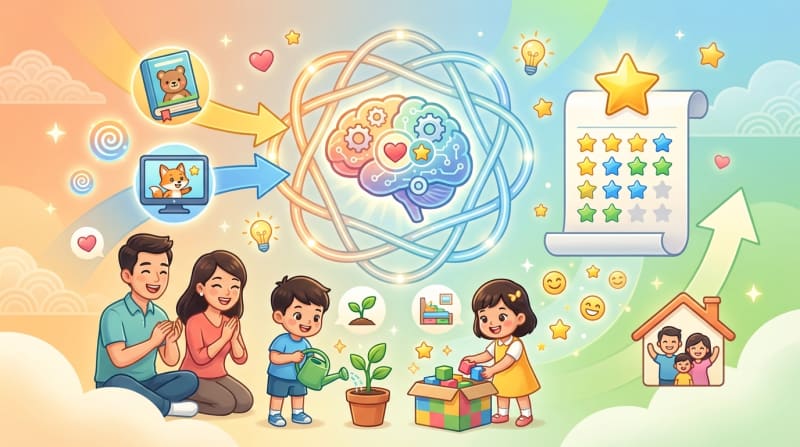
Biologically, every time a child repeats an action, the connections between nerve cells (neurons) are strengthened. Imagine the brain as a dense forest. The first time you walk through, the path is very faint and difficult to traverse. But if the child walks that path every day, the grass wears down, forming a clear, beaten path that is much easier to walk on.
Repetition helps turn new, difficult skills into something . This is how children learn to speak, learn to walk, and of course, learn to do chores.