Teaching Children the Skill of Delayed Gratification: The Key to Success
Have you ever found yourself in a laugh-or-cry situation where your child lies on the supermarket floor demanding a toy, or insists on eating sweets right before dinner? These are very natural reactions in young children: the desire to have their needs met immediately.
However, in the journey of raising children, there is a "golden skill" that psychological experts always encourage parents to cultivate early on. It is Delayed Gratification. This is not just about teaching children how to wait, but it is the core foundation for building a mindset of success and prosperity in the future.
1. Lessons from "The Marshmallow Test"
In the 1960s, Stanford University (USA) conducted a famous psychological experiment called "The Marshmallow Test." In this experiment, children were led into a room with a marshmallow (or cookie) in front of them. The researcher made a tempting offer:
"You can eat this marshmallow right now. But if you wait for me to go out and come back in 15 minutes, and the marshmallow is still there, you will get another one as a reward (for a total of 2)."
The results of tracking these children over the following decades shocked the world of psychology. The children who had the ability to resist temptation to wait for the larger reward (2 marshmallows) tended to have much more successful lives as adults. Specifically, they had better academic results, healthier BMI scores, better stress management skills, and achieved more social success.
This experiment proves that: The ability to exercise self-control and delay immediate gratification is a key indicator of future success.
2. Why is the concept of the "Future" difficult for children?
Understanding the importance is one thing, but applying it in reality is another. Parents often say: "Try to study hard, and at the end of the year, Mom and Dad will buy you a bike" or "If you are good all week, you can go out on the weekend."
For adults, a week or a year is a defined period. But for children, especially those under 6, the concept of time and the "future" is extremely vague.
- Visual Thinking: Children live for the present. A promise of a reward at the "end of the year" is too distant, causing children to easily get discouraged and lose motivation after just a few days.
- Natural Impulsiveness: The prefrontal cortex (responsible for behavior control and decision-making) in children is not as fully developed as in adults, making it incredibly difficult to curb desires.
So how do we teach this skill without causing pressure, while turning waiting into joy? The answer lies in "visualizing" the wait.
3. The "Goal Breakdown" Strategy and the Power of Accumulation
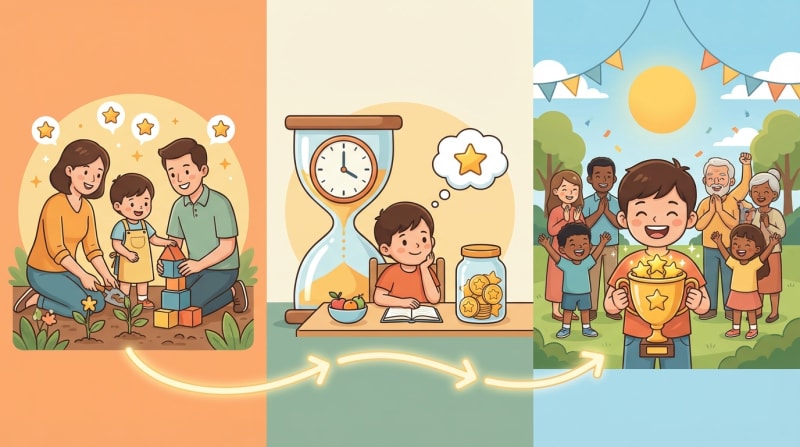
Instead of asking children to wait indefinitely, parents can turn the waiting time into an exciting journey of accumulation. This is the method that Tasky Kid applies to support parents: The Token Economy mechanism (Exchanging chores for rewards).
Imagine practicing patience is like your child playing a game to level up:
Step 1: Establish an "effort currency"
Instead of using real money, use "Stars" or "Points" on the Tasky Kid app. Every time your child completes a small task (brushing teeth, cleaning up toys, doing homework), they will receive a certain number of stars.
- This helps the child understand: Rewards do not appear naturally; they come from labor.
Step 2: Categorize rewards (Short-term vs. Long-term)
This is the most important step in teaching delayed gratification. Parents should work with their children to set up a list of rewards on the app:
- Small Rewards (Immediate Temptation): Example: Watching TV for 30 minutes, eating an ice cream. These items cost few stars (e.g., 10 stars). The child can achieve this within the day.
- Big Rewards (Long-term Goals): Example: A new Lego set, a trip to the water park, branded shoes. These items require many stars (e.g., 200 stars).
Step 3: Empower the child to choose
When the child has accumulated 10 stars, they will face a choice:
- Option A: Exchange immediately for 30 minutes of TV (Immediate Satisfaction). Star count goes to 0.
- Option B: Resist the urge to watch TV, keep those 10 stars, and continue working to accumulate enough for the dream Lego set (Delayed Gratification).
At this point, the Tasky Kid app acts as a visual tracking board. When the child sees the progress bar inching up every day, the concept of "waiting" is no longer boring. They can see the goal getting closer thanks to their own efforts.
4. Outstanding benefits when applying this method with Tasky Kid
Applying technology to parenting not only makes things easier for parents but also delivers profound lessons:
- Cultivating Perseverance: Children understand that great things require time and effort. No success comes overnight.
- Basic Financial Management Skills: Children learn how to "save" (accumulate stars) and "spend" (exchange for gifts) reasonably. They will learn the concept of opportunity cost: If they spend stars on TV now, the day they own the Lego set will be further away.
- Boosting Confidence: The feeling of "earning" a favorite toy through labor will make the child cherish that gift many times more than if it were given for free by parents.
5. Tips for parents when starting out
For this method to succeed, parental consistency is the deciding factor:
- Don't be soft-hearted: If the child has spent all their stars to watch TV, absolutely do not buy the Lego set for them immediately afterwards, even if they cry. Let the child experience the result of their choice.
- Encourage their spirit: When the child decides not to exchange for a small gift to save stars, praise them: "Mom/Dad is very proud that you know how to be patient. You are getting very close to that Lego set!"
- Start small to big: For beginners, set long-term goals that are within reach (about 3-5 days) so the child gets used to the feeling of winning, then gradually extend the time.
Conclusion
Teaching children to wait is not about making them suffer, but about equipping them with a prosperity mindset. Children who know how to delay gratification today will be the masters of their destiny, knowing how to invest in the future and reap brilliant success tomorrow.
Let technology be your effective assistant in this journey. With a vivid, friendly interface and a smart reward accumulation mechanism, Tasky Kid will turn dry lessons about patience into exciting challenges that kids are eager to join every day.
👉 Are you ready to conquer the modern version of the "Marshmallow Test" with your child? Download the app and set up the first goal for your child right at: https://taskykid.com
🌟 Obtenez Tasky Kid Maintenant
Aidez votre enfant à prendre de bonnes habitudes avec une application de gestion des tâches pour enfants !
Télécharger Gratuitement