Why Your Child "Fakes Deafness" When Doing Chores and How to Handle It Effectively
Are you raising an "acoustics expert"?
Have you ever found yourself in this laughable yet tear-jerking situation? You stand right next to your child, take a deep breath, and say clearly: "Sweetie, please put these toys away in the box for Mommy!".
What is the response? A numbing silence. The room is quiet, the air feels thick. Your child’s eyes remain glued to the TV screen or comic book, wearing an innocent face as if Mom is emitting ultrasonic waves that normal human ears cannot detect. You start to wonder: "Does my child have a hearing problem?".
But wait! That very same child, just 5 minutes later, when you are downstairs in the kitchen whispering to your husband: "I think we still have a bag of chips left in the cabinet...".
The Reaction: Even from the second floor, behind a closed door, the "little boss" hears it and rushes down like a tornado: "Where is it, Mom? Can I have some?".
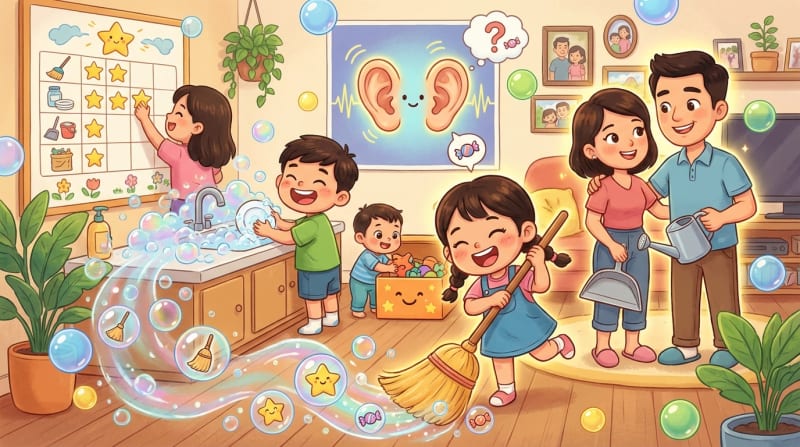
Welcome to the mysterious world of "Selective Hearing" – a special "feature" that almost all children possess. Don't worry too much, your child isn't deaf; they are just... filtering information! So how do you penetrate that "active noise cancellation" eardrum without screaming until you lose your voice? Let’s find the answer.
Decoding the "Selective Deafness" Phenomenon in Children
From the perspective of psychology and brain development, this phenomenon is completely normal (even if it is extremely frustrating for parents). There are a few main reasons why children "hear the sound of candy" but go "deaf to the sound of a broom":
Single-Tasking Focus: A child's brain has not fully developed multi-tasking abilities like an adult's. When a child is focused on playing Lego or watching cartoons, their brain automatically "closes the door" to surrounding background noise – including Mom's nagging.
The Dopamine Filter: The human brain always prioritizes information that brings joy or rewards (Dopamine). The sound of "chips" promises an immediate sweet reward. The sound of "clean the house" promises fatigue and boredom. Naturally, the child's brain will select which signal is worth processing.
** The Habit of Being Reminded:** If parents often have to repeat themselves 5-10 times before issuing a punishment, the child learns that: "Mom's words the first or second time aren't important; I only need to act when her voice gets gritty."
The Classic Parental Mistake: Increasing Volume Instead of Changing Frequency
When children don't listen, our natural reflex is to speak louder, then shout, and even threaten. However, this approach often backfires:
Causes Stress: It turns the home into a "battlefield" filled with shouting.
Building Tolerance: The child gets used to only acting when parents are angry.
Loss of Connection: The child does chores with resentment and resistance, not willingness.
Instead of trying to "pierce" your child's eardrums with volume, parents should try switching to a "language" that every child loves: The Language of Gaming!
Turn Chores into an Adventure with "Quests" and "Rewards"
Think back to your child's shining eyes when playing video games. Why can they sit for hours to "grind" in a game? Because games have clear goals, instant feedback, and attractive rewards.
Why don't we apply that mechanism to real life?
1. From "Orders" to "Quests"
Instead of saying: "Go clean your room now!" (which sounds like a command), try setting up a task on an app or a bulletin board: "Quest: Rescue the Floor from the Lego Monsters."
2. From "Things to Do" to "Opportunities to Earn Stars"
Children don't care about a clean house (that's the parents' need). Children care about what they get.
Cleaning up toys = 2 Gold Stars.
Folding clothes = 3 Gold Stars.
Brushing teeth independently = 1 Gold Star.
3. From "Empty Promises" to "Tangible Rewards"
Accumulated stars can be exchanged for "privileges" that the child craves:
20 stars = 1 ticket to the water park this weekend.
10 stars = An extra 30 minutes of TV.
5 stars = A bag of chips (the thing they heard very clearly from the second floor!).
Tasky Kid - The Powerful Assistant for "Hearing Restoration"
If parents feel that keeping a notebook or cutting and pasting paper stars is too complicated, then Tasky Kid is the 4.0 technology solution for your family.
The app is specifically designed to turn household management into a colorful and exciting game.
Why is Tasky Kid more effective than words alone?
Visualized Tasks: The to-do list is illustrated with vivid, cute images, suitable even for children who cannot read well yet.
Sense of Achievement: Every time the child ticks the "Complete" box, fun sounds and flying star effects stimulate the brain, creating a feeling of victory.
Empowerment: The child no longer waits for Mom to remind them. They will proactively open the app to check: "What can I do today to earn more stars?". Many kids even remind their parents to assign more tasks!
Fairness and Transparency: All rewards are clearly convertible. No more scenes of children whining or making unreasonable demands, because they understand: "To get a gift, I need stars. To get stars, I must work."
Conclusion: Don't Let Nagging Age You Every Day
Teaching children to do housework is not just about keeping the house tidy; it is about training responsibility, independence, and discipline. But that journey doesn't have to be paved with shouting and tears.
When parents change their approach, their child's "hearing" will automatically be restored to 100%. Let Tasky Kid help you turn cleaning "battles" into happy, bonding family moments.
Don't wait for a miracle, create one today!
👇 Start your easy parenting journey here:
👉 Download the app and create a free account:https://taskykid.com