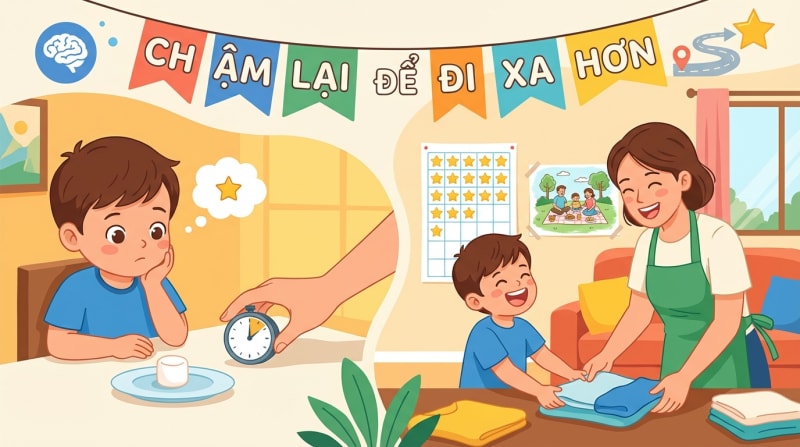
The Secret to Teaching Kids Persistence: Lessons from the Marshmallow Test
Have you ever found yourself in a tricky situation where your child demands a new toy immediately, despite having plenty of similar ones at home? Or perhaps they can't sit still for 15 minutes to finish their homework because they want to watch TV right now?
In an age where everything happens in the blink of an eye, patience seems to have become a "luxury." However, psychologists affirm that the ability to wait is not just a virtue, but a key predictor of a child's future success.
So, how do we teach children to "slow down" a little in order to go further? Let's explore the skill of Delayed Gratification and how to apply it simply and effectively right at home.
1. The "Marshmallow Test" and the Prophecy of Success
In the 1960s, Professor Walter Mischel at Stanford University conducted a classic psychological experiment known as "The Marshmallow Test."
The rules were very simple: A child was brought into an empty room with a marshmallow (or cookie) on a table. The researcher made an offer:
- The child could eat the marshmallow right now.
- Or, if the child waited for the researcher to return (after about 15 minutes), they would be rewarded with an extra one, meaning they would have two marshmallows.
The results from tracking these children over the following decades were truly astounding. The children who had the ability to suppress their immediate cravings to wait for the larger reward (2 marshmallows) typically had better academic results, healthier BMIs, better stress management skills, and achieved more success in their careers compared to the group that ate the candy immediately.
This skill is called Delayed Gratification – the ability to postpone short-term pleasures to achieve more valuable long-term goals.
2. The Challenge of the "I Want It Now" Era
Although we know patience is good, training this skill in children today is harder than ever. We are living in the digital age of Instant Gratification:
- Want to watch cartoons? Just one click, no need to wait for broadcast times like in the old days.
- Want entertainment? TikTok and YouTube Shorts provide joy in just seconds.
- Playing games? Win a round and receive a loot box immediately.
The child's brain gradually gets used to receiving a "reward" (dopamine) immediately after an action. This inadvertently reduces the capacity for sustained effort. When facing a difficult math problem that requires time to think, or a household chore that takes 30 minutes, children easily become discouraged and give up because they don't see immediate results.
3. Turning Theory into Action with Tasky Kid
Understanding this psychology, we cannot simply pay lip service and tell our children, "You must be patient." Children need a visual tool, a "game" to practice this waiting skill every day.
This is where Tasky Kid becomes a powerful assistant for parents through the Accumulate Stars for Gifts feature.
Instead of rewarding them immediately every time they finish a small task (e.g., giving candy right after sweeping the floor), parents should set up a smart "delay" system:
Step 1: Set Short-term and Long-term Goals
Sit down with your child and discuss the reward list on the Tasky Kid app. Parents should divide rewards into levels:
- Level 1 (Short-term Joy - Easy to Reach): 10 stars = 1 ice cream cone, 1 hour of TV.
- Level 2 (Medium-term Goal - Requires Effort): 50 stars = A trip to the cinema, a new comic book.
- Level 3 (Long-term Goal - "Two Marshmallows"): 100 - 200 stars = A dream Lego set, branded shoes, or a trip to the water park.
Step 2: Encourage Your Child to "Save" Stars
When the child accumulates 10 stars, they face a choice identical to the Marshmallow Test:
- Exchange immediately for an ice cream (Stars are gone, must start over).
- Keep those stars and continue doing chores to aim for the Lego set (The bigger goal).
At this point, the Tasky Kid app acts as an "achievement bank." Seeing the number of stars increase every day on the screen helps children visualize their progress, giving them extra motivation to wait.
4. Double Benefits When Applying This Method
When parents use Tasky Kid to practice delayed gratification, the child doesn't just learn how to do chores. The values they receive are much greater:
- Financial Mindset Training: They understand that "assets" (stars) need to be accumulated to exchange for valuable items. Spending wastefully on small pleasures will make big goals increasingly distant.
- Enhanced Self-Control: Children learn to fight against immediate temptations on their own.
- Nurturing Resilience: They understand that the best things don't come easily but require time and effort.
5. Advice for Parents
For this method to be successful, parents need to note:
- Keep Your Promise: When your child has accumulated enough stars and decides to redeem a gift, parents must fulfill that reward as soon as possible to build trust.
- Don't Forbid Everything: Sometimes the child wants to redeem a small (short-term) reward; respect their decision. Afterward, gently analyze: "If you hadn't exchanged for the ice cream today, you would only be 3 days away from getting that toy set." Let the child draw the lesson themselves.
- Lead by Example: Share your own long-term goals with your child (e.g., saving money to buy a car, exercising to stay healthy) so they see that adults practice "delayed gratification" too.
Conclusion
Teaching children to "slow down" does not mean stifling their joy; it means equipping them with the bravery to embrace greater joys in the future.
Each star your child accumulates on Tasky Kid today is a brick building their persistence and success tomorrow. Start this exciting journey with your child today!
👉 Download the Tasky Kid app and set up a smart reward system at: https://taskykid.com
🌟 Obtén Tasky Kid Ahora
¡Ayuda a tu hijo a desarrollar buenos hábitos con una app de gestión de tareas!
Descargar Gratis