Teaching Children Delayed Gratification: A Skill More Important Than IQ
Have you ever found yourself in this tricky situation: You are at the supermarket, and your child suddenly throws a tantrum on the floor just because they want to buy a toy immediately? Or right after dinner, they insist on eating candy and cannot wait even a single minute?
If the answer is "Yes," don't worry too much. This is completely normal psychology for young children. Children often live in the "right now." For them, needs and wants must be met instantly. Concepts like "waiting" or "later" are incredibly abstract and difficult to accept.
However, for a child to mature and succeed, learning to control these immediate impulses is absolutely essential. In psychology, this skill is called "Delayed Gratification."
So why do experts rate this skill as more important than Intelligence Quotient (IQ)? And how can you train the "patience muscle" for your child through daily activities? Let's explore this deeply with Tasky Kid in the article below.
1. What is Delayed Gratification and why is it important?
Delayed Gratification is the ability to resist the temptation of an immediate reward to wait for a larger, more valuable reward in the future.
One of the most famous studies on this topic is "The Marshmallow Test" by Stanford University in the 1960s. In this experiment, children were offered a marshmallow and given two choices:
- Eat it immediately.
- Wait 15 minutes and receive a second marshmallow as a reward.
Follow-up results over many years showed: The children who were able to wait to receive 2 marshmallows generally had better academic performance, higher emotional intelligence (EQ), better stress tolerance, and were more successful in their careers compared to the group that chose to eat immediately.
This proves that patience and self-discipline are indicators of success that are far more accurate than innate talent.
2. Why is it so hard for young children to be patient?
Parents need to understand that patience is not an instinct; it is a skill that needs to be trained.
Biologically, the area of the brain responsible for impulse control and planning (the prefrontal cortex) in children is not yet fully developed. That is why when seeing a toy or a cake, the child's brain signals "Want it now!" and it is very difficult for them to turn off that signal on their own.
When a child has to wait, feelings of discomfort and restlessness arise, leading to behaviors like irritability or tantrums. The parents' task is not to forbid or punish, but to provide the child with tools and methods to overcome that discomfort and aim for a further goal.
3. The Secret of "Visualizing" the Wait: Turning the Invisible into the Visible
A common mistake many parents make is using abstract promises to teach patience, for example: "If you are good, we will go out this weekend," or "Study hard and Mom will reward you at the end of the year."
For young children, "this weekend" or "end of the year" are periods that are too long and vague. They cannot see the connection between their actions today and the reward in the future.
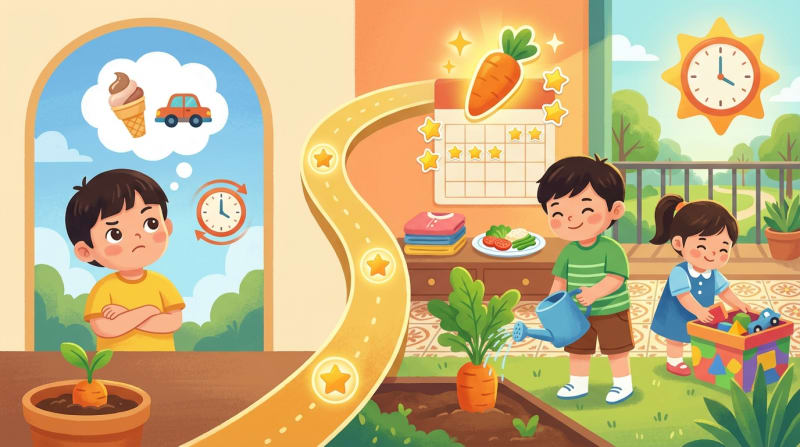
The best way to teach this skill is to "visualize" progress. Let the child see and touch the accumulation of their efforts every day. This is where Tasky Kid's educational method comes into play.
Setting up the "Carrot" System
Instead of empty promises, parents should work with their children to set up a clear roadmap on the Tasky Kid app or a home chart:
- Step 1: Identify the Goal (Big Reward): Ask your child what they want. A new Lego set? A trip to the water park? Or simply an extra 30 minutes of TV?
- Step 2: Convert to Effort (Stars/Points): Value that goal. For example: A Lego set equals 100 stars.
- Step 3: Break Down Daily Tasks: To get 100 stars, what does the child need to do each day? (Folding blankets: 2 stars, Brushing teeth independently: 2 stars, Doing homework: 5 stars...).
Lessons on Accumulation
When applying this method, children will learn priceless lessons:
- Persistence: The child understands that they cannot have the Lego set immediately, but with each passing day, the number of stars in their Tasky Kid "savings jar" increases. They are getting closer to the goal.
- Cause and Effect: Doing good work (Cause) increases stars (Effect). Being lazy pushes the goal further away.
- The Value of Labor: A toy exchanged for 100 stars earned by their own labor will be cherished much more than a toy demanded and bought instantly.
4. What should parents do to accompany their children?
Installing an app or making a chart is just the first step. To successfully train the "patience muscle" for your child, parents need to note:
- Start with small goals: For young children (3-5 years old), the waiting time shouldn't be too long. Set goals achievable in 2-3 days so they don't get discouraged. As the child grows, extend the accumulation period to 1 week or 1 month.
- Keep your promises: This is the golden rule. When the child has accumulated enough required stars, parents must give the reward as agreed. If parents break their promise, the child's trust will shatter, and they will revert to the "demand and get it now" habit.
- Encourage the process, not just the result: Praise your child whenever they complete a daily task. "Mom sees you tried very hard to finish cleaning up your toys today; you've taken another step closer to that Lego set!"
- Be a role model: Children learn through observation. If parents also show patience, know how to wait, and work with a plan, children will automatically follow suit.
5. Conclusion
Teaching children to delay gratification is not about making them suffer, but about equipping them with a solid "shield" to face future challenges.
When children see the number of stars on Tasky Kid increase day by day thanks to their own efforts, they will deeply understand the philosophy: The best things are worth waiting and striving for.
Parents, start the journey of training patience for your child today with the smallest actions. Turn boring waiting into an exciting game of accumulation and conquest.
👉 Are you ready to conquer the patience challenge with your child? Download the Tasky Kid app for free to start setting goals and tracking your child's progress every day!
📲 App download link: https://taskykid.com
#TaskyKid #TeachingPatience #ParentingTips #LifeSkillsForKids #ScientificParenting
🌟 Obtén Tasky Kid Ahora
¡Ayuda a tu hijo a desarrollar buenos hábitos con una app de gestión de tareas!
Descargar Gratis