📚 EducationalFriday, February 13, 2026|562 vistas
⭐
Cargando...
¡Sólo un momento!
¡Sólo un momento!
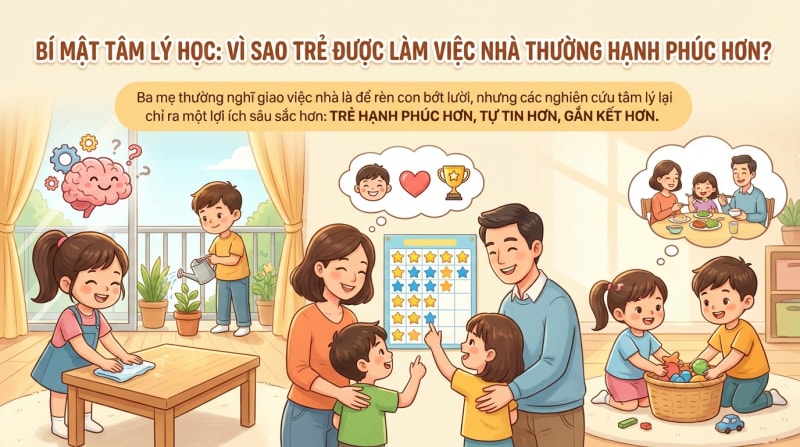
In our busy modern lives, the image of "superhuman" parents juggling work and household chores while their children simply sit studying or watching TV has become all too familiar. Many parents believe: "My life was hard, so I sacrifice to make my child's life comfortable; they just need to do well in school." However, from the perspective of psychological experts, this "sacrifice" sometimes inadvertently deprives children of a vital mental need.
Have you ever wondered: Why are children who participate in family responsibilities often more confident, cheerful, and less rebellious? The answer lies in a profound psychological secret: The Sense of Belonging.
Let’s join Tasky Kid in analyzing why housework isn't just manual labor, but a "tonic" for a child's mental well-being.
According to the Individual Psychology theory of Alfred Adler (one of the three pillars of modern psychology alongside Freud and Jung), the most basic and powerful human need is to feel that one belongs and contributes to a group.
For a child, the first and most important "group" is the family. Children don't just want to be passively loved and pampered; they crave recognition as a useful member.
When a child is assigned tasks like wiping the table, watering plants, or folding clothes, the message their brain receives isn't "Mom and Dad are lazy so they make me do it," but rather:
It is this feeling of "I have value" that forms the solid foundation for building Self-esteem from a young age.
Many parents hesitate to assign chores for very practical reasons: fear that the child will break things, get tired, or simply because "it's faster if I do it; if the child does it clumsily, I’ll just have to clean it up again."
However, try looking at the issue from the child's perspective. When you snatch the broom from their hands saying, "Leave it there, I'll do it," or when you serve them from A to Z (getting water, tying shoelaces, cleaning their room), you are unintentionally sending negative signals:
Over time, this forms a mindset of "Learned Helplessness." Children become reliant, lack confidence when facing new challenges, and always wait for others to solve problems for them. A child who never has to lift a finger for housework will struggle to feel the happiness derived from effort and achievement.
Studies, including the 75-year-long Harvard Grant Study, have shown that: Career success in adulthood is directly proportional to whether a person did chores as a child.
Why is that?
Instead of giving orders or using chores as punishment, parents should turn housework into a "privilege" of contribution. Here are some suggestions to get started:
Don't expect the child to clean perfectly the first time. Start with:
Instead of saying "Go clean your room now!", try saying: "Mom is really busy cooking, could you help me clear the table so the whole family can eat sooner? I really need your help." Asking for help triggers the "knight" spirit and responsibility within the child.
If the table isn't perfectly clean, don't rush to criticize. Praise their spirit first: "Thank you for helping me, I feel much less tired. There's a tiny spot left here, just a quick wipe and it will be perfect!"
Understanding that children always love fun and rewards, Tasky Kid was created to help parents turn boring chores into an exciting game.
With Tasky Kid, parents can:
This applies the mechanism of "Positive Reinforcement" in behavioral psychology. Children won't feel forced, but excited because their efforts are recognized fairly and deservedly.
Don't let love become a barrier preventing your child from growing up. Give your child the opportunity to work, to be wrong, to fix mistakes, and to feel valuable in the family. A happy child is not the most pampered child, but the child most confident in their own abilities.
Start the journey of building independence and family bonding today with Tasky Kid!
👉 Download the app and set up chores for your child at: https://taskykid.com
¡Ayuda a tu hijo a desarrollar buenos hábitos con una app de gestión de tareas!
Descargar Gratis