Does Your Child "Play Deaf" During Chores? The Ultimate Cure | Tasky Kid
🎉 FunSaturday, December 27, 2025|1018 vistas
Does Your Child "Play Deaf" During Chores? The Ultimate Cure
Have you ever found yourself in this ironic situation? You're downstairs, quietly unwrapping a candy or opening a bag of chips, and in a split second, your child from the second floor appears right beside you like a ninja with glowing eyes?
Yet, paradoxically, when you stand right next to them and speak clearly: "Honey, put away your toys" or "Let's go take a bath", there seems to be an invisible soundproof wall. They stay glued to the TV screen or keep playing Lego as if you were completely invisible.
Welcome to the club of parents whose children suffer from "Selective Hearing" syndrome. Don't worry too much or rush to the ENT specialist, because this is actually a common "condition" that almost every child has, especially when facing... chores!
Let's join Tasky Kid to decode this interesting phenomenon and find a "special prescription" to help parents get obedience without screaming their lungs out.
1. "Selective Hearing" Syndrome: When Ears Know How to Filter
Scientists humorously call this Selective Hearing. Basically, children's ears work perfectly fine, but their brains have a highly sophisticated "filter" mechanism.
This mechanism operates on the Interest and Benefit principle:
Priority High Sounds: The sound of a candy wrapper, the intro music of a favorite cartoon, a game console notification, or keywords like "go out," "ice cream." These sounds stimulate the brain to release Dopamine (the happiness hormone) immediately, causing the child to react in 0.01 seconds.
Blocked Sounds: Mom urging to clean the room, reminders to study, calls to wash dishes. To children, these are signals "threatening" their current fun, so the brain automatically switches to: "The subscriber you are calling is currently busy... playing!" mode.
This isn't malicious defiance, but sometimes just a natural defense mechanism to protect their joy.
#TaskyKid#NuoiConThongMinh#ViecNha#HaiHuocGiaDinh
🌟 Obtén Tasky Kid Ahora
¡Ayuda a tu hijo a desarrollar buenos hábitos con una app de gestión de tareas!
When seeing a child "play deaf," the natural reaction of most parents is to increase the volume. We start speaking louder, repeating ourselves, and finally screaming in anger.
However, child psychologists warn that this often backfires for two reasons:
Sound Desensitization: When a child's brain gets used to the idea that parents must scream for it to be a "real order," they will ignore all gentle requests beforehand. Children learn the rule: "No need to do it yet; Mom hasn't screamed, so it's not urgent".
Creating Psychological Barriers: Yelling produces Cortisol (stress hormone). Instead of wanting to cooperate, children develop resistance, resentment, or do chores in a coping manner just to get it over with.
So how do we "reconnect" the signal without using force?
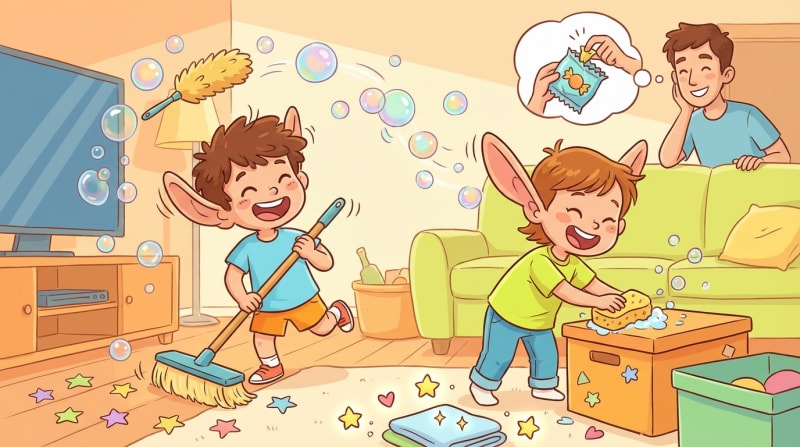
3. Special "Prescription": Turning Chores into a Star Hunting Mission
If children only hear what they find interesting, why don't we make boring chores as attractive as a game? This is where technology and the Gamification method of Tasky Kid come into play.
Instead of dry reminders, try applying the "Star Hunting Mission" method:
Change the way you communicate
Instead of saying: "Go sweep the house for me right now!", let the Tasky Kid app send a fun notification to your child's device (or check together on your phone).
The power of visual rewards
Children think very visually. The promise "Mom will take you out this weekend" is often too distant. But a sparkling gold star ⭐ appearing right when they finish folding clothes brings instant satisfaction.
On Tasky Kid, every chore is attached to a specific number of points or stars.
Brushing teeth voluntarily: 1 ⭐
Tidying the study corner: 2 ⭐
Helping Mom wash vegetables: 3 ⭐
Empowering autonomy
When using the app, children no longer feel bossed around. They are performing a "hero's mission" to accumulate assets (stars) for themselves. The feeling of being in control will miraculously restore the hearing of your "little troublemakers."
Exchanging stars for gifts - Long-term motivation
Accumulated stars can be exchanged for practical gifts the child has "registered" for in the app, for example: 30 minutes of TV, a new comic book, or a fried chicken dinner. When the goal is clear, the child's ears will automatically "tune in" very sensitively to assigned tasks.
4. Small Tips for More Effective Communication
Besides using the "powerful assistant" Tasky Kid, parents can combine the following techniques to cure "selective hearing":
"Eye Contact" Rule: Don't shout from the kitchen to the living room. Go close to your child, get down to their eye level, and place your hand on their shoulder before making a request. This physical connection helps break their focus on the TV/toys.
Short Commands: Don't give long speeches. Instead of "How many times have I told you to put things away after playing, the house is a mess...", simply say: "Toys need to be in the basket in 5 minutes".
Ask for repetition: After assigning a task, gently ask: "Can you repeat what your mission is?" to ensure the signal has been "downloaded."
Conclusion
"Selective Hearing" is not an incurable disease; it's just a small challenge in the journey of raising children. Instead of letting frustration escalate, parents should try changing tactics: less nagging, more fun.
Let technology speak for you. When chores become an exciting star-hunting race, you'll be surprised to see your child not only "hearing clearly" but also participating enthusiastically.
👉 Are you ready to "cure" your child's fake deafness? Download Tasky Kid now and start the fun star-hunting journey at:https://taskykid.com