📚 EducationalThursday, February 05, 2026|724 vistas
Delayed Gratification: The Golden Secret to Raising Successful Children
Have you ever found yourself in this awkward situation: Your child screaming in the middle of the supermarket because they want a toy immediately, even though they have dozens of similar ones at home? Or does your child easily give up on a complex Lego set after just 5 minutes?
In this digital age of instant gratification, patience is becoming a "luxury asset" for young children. However, science has proven that the ability to control immediate desires is actually one of the most accurate predictors of a person's future success.
So, how can you train this skill in your child without resorting to punishment or shouting? Let's join Tasky Kid in finding the answer through a famous psychological experiment and modern educational methods.
1. Lessons from the "Marshmallow Test" and the Secret to Success
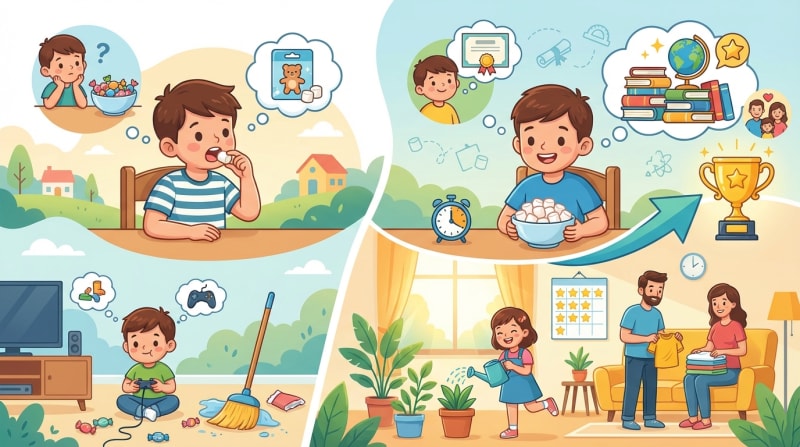
In the 1960s, Stanford University conducted a classic experiment called "The Marshmallow Test". Preschool children were led into a room with a marshmallow placed in front of them. The researcher offered a simple deal:
"You can eat this marshmallow right now. But if you can wait for me to come back in 15 minutes without eating it, I will reward you with another one (making it 2 marshmallows in total)."
The results of tracking these children over the next 40 years were astounding. The children who had the ability to practice "delayed gratification" to wait for the larger reward tended to have:
Higher academic scores (SAT).
Better emotional management and stress tolerance.
Healthier Body Mass Index (BMI).
More successful careers and stable social relationships.
Conversely, children who couldn't resist eating the candy immediately often faced more difficulties in maintaining focus and persisting with long-term goals.
2. The Challenge of the "One-Touch" Era
#TaskyKid#DayConKienNhan#KyNangSong#ParentingTips
🌟 Obtén Tasky Kid Ahora
¡Ayuda a tu hijo a desarrollar buenos hábitos con una app de gestión de tareas!
Even though we know patience is good, teaching children this skill in the 21st century is infinitely harder. Why?
Technology: Want to watch cartoons? Just one touch on the iPad. Want to listen to music? It's instantly on Spotify.
Services: Fast food, 2-hour delivery...
Everything happens so fast that a child's brain gets used to receiving Dopamine (the happiness hormone) instantly. When they have to wait or put in effort over a long period to get results, children easily develop a mindset of boredom, irritability, and giving up. This is when parents need smart support tools to "reprogram" their child's thinking.
3. Tasky Kid: Turning "Waiting" into an Exciting Game
Instead of dry moral lectures about patience, Tasky Kid applies behavioral psychology mechanisms through the feature "Accumulate Stars to Redeem Gifts". This is essentially a modern, practical version of the Stanford Marshmallow Test.
Here is how Tasky Kid helps children practice delayed gratification naturally:
Step 1: Set a Big Goal (The Big Reward)
Instead of rewarding your child with an ice cream immediately after they sweep the floor (an instant reward), parents should discuss a larger gift that the child desires. It could be a cool building block set, a trip to the water park, or a new comic book.
The Lesson: The child learns to identify goals and understands that great things take time to achieve.
Step 2: "Filling the Piggy Bank" with Stars (Accumulation)
On the Tasky Kid app, parents will convert that gift into a corresponding number of stars (e.g., 50 stars). Every day, when the child completes small tasks like making the bed, doing homework, or helping mom pick vegetables, they will receive 1-2 stars.
The Lesson: The child understands the value of labor. They learn that small efforts every day add up to something big. The feeling of watching the star count increase day by day acts as motivation for them to keep trying.
Step 3: Enjoying the Well-Deserved Result
The moment the child accumulates enough 50 stars and redeems them for their wished-for gift brings a burst of happiness far greater than if their parents had bought it for them immediately.
The Lesson: The child feels the sweet taste of patience and pride in themselves. This is the foundation of self-esteem.
4. Tips for Parents to Effectively Companion Their Children
To make the most of Tasky Kid's features, parents should keep the following in mind:
Don't set goals too far out: For young children (under 6 years old), set rewards that can be achieved within 3-5 days. If the wait is too long, the child will easily get discouraged. For older children, parents can extend the time to 2 weeks or a month.
Visualize progress: Frequently open the Tasky Kid app to show your child the progress bar or the number of stars they have. Visual images help maintain their interest.
Praise the process, not just the result: When your child is trying to do chores to earn stars, encourage them: "I see you working very hard to reach your goal, and I am very proud of your persistence."
Lead by example: Parents should also demonstrate patience in daily life. Share with your child that you are also saving money (accumulating) to buy a household item or go on a trip.
Conclusion
Training the skill of "Delayed Gratification" is not about forcing children to suffer, but equipping them with a sturdy "shield" to face future challenges. A child who knows how to wait and strive for long-term goals will undoubtedly become a resilient and successful adult.
Let small daily chores like cleaning the room or washing dishes become valuable lessons in patience. And don't forget, Tasky Kid is always ready to be a powerful companion for parents on this journey.
👉 Download Tasky Kid and start setting goals with your child today:https://taskykid.com
🏠 Weekend
🏠 Giao việc nhà cuối tuần sao cho "chuẩn bài" để con vui vẻ hợp tác m
📅 Sunday, May 24, 2026
Delayed Gratification: The Golden Secret to Raising Successful Children | Tasky Kid