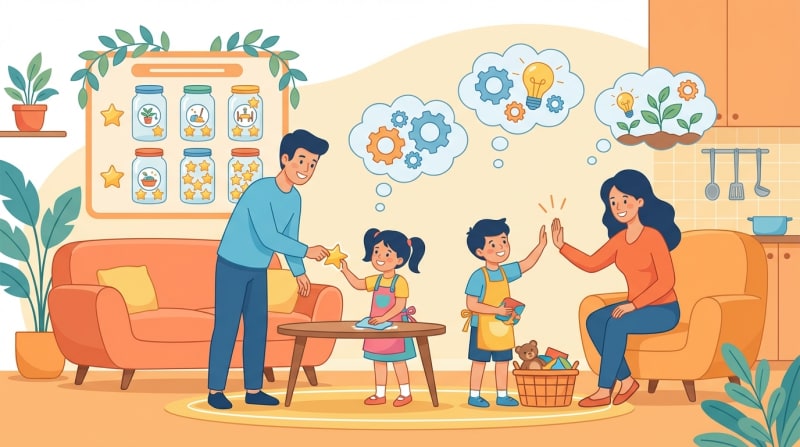
Can Praise Have "Side Effects"? The Art of Praising Your Child the Right Way
In the journey of raising children, praise is always seen as a precious "morale booster" that helps children feel confident and happy. Most parents believe that frequently saying things like "You're so smart," "You're so talented," or "You're such a good child" will help their kids maximize their potential.
However, have you ever thought that praise might actually have "side effects"?
Modern psychological studies have pointed out a surprising paradox: Sometimes, praise focused on innate traits inadvertently creates pressure, making children fear failure and hesitate to face challenges. So, how do we praise children correctly to help them build resilience rather than just satisfying their ego temporarily? Let's find the answer with Tasky Kid in the article below.
1. When praise becomes a "sweet trap"
Imagine your child solves a difficult math problem, and you exclaim: "You are so smart!". The child feels very happy and proud. But the underlying message they receive is: "I did this because I am smart."
So, what happens when they encounter a harder problem and can't solve it?
Children will easily infer the opposite: "I can't solve it, which means I'm not smart anymore." At this point, failure is no longer part of the learning process but becomes proof of incompetence. To protect the "smart" label parents have given them, children tend to:
- Avoid challenges: Only choose easy tasks to ensure success.
- Give up easily: Quit at the first sign of difficulty because they believe they lack the ability.
- Hide flaws: Fear asking questions or admitting they don't understand for fear of being judged.
This is a manifestation of a "Fixed Mindset" – the belief that intelligence or talent are innate traits that cannot be changed.
2. Shifting to a "Growth Mindset"
Professor Carol Dweck from Stanford University, author of the famous book “Mindset: The New Psychology of Success”, has spent decades researching this issue. She offers core advice to parents: Focus on praising EFFORT and PROCESS, rather than innate traits.
When praise is tied to specific actions and effort, children develop a "Growth Mindset". They will understand that:
- Success comes from practice and hard work.
- Failure is just a sign that they need to try harder or change their method.
- Intelligence can be cultivated over time.
3. The "Praise the Effort" Formula – A Golden Key for Parents
Changing the habit of using certain words is not easy, but it brings immense impact. Here are some specific examples for parents to switch from praising traits to praising the process:
Instead of saying: "You're so good / You're so smart"
👉 Try saying: "I see you were very focused on solving this math problem. You tried many different ways and finally found the answer. That is very commendable!"
Instead of saying: "You're such a good child"
👉 Try saying: "Thank you for cleaning up your toys on your own after playing without me having to remind you. The room looks very tidy and clean now!"
Instead of saying: "You're a genius artist"
👉 Try saying: "This picture has very harmonious colors. Dad sees that you colored very carefully without going outside the lines at all. How much time did you spend drawing this?"
General Principles:
- Be specific: Point out exactly which action is being praised.
- Acknowledge effort: Emphasize persistence, focus, or the strategy the child used.
- Describe the result: Talk about the positive impact of the child's action (e.g., the house is clean, homework is finished).
4. Tasky Kid – The Companion Helping Parents Practice "Praising Correctly"
Understanding the importance of building habits and mindset for children, Tasky Kid is not just a chore management app, but also a tool to help parents become excellent psychological "coaches."
Tasky Kid is designed based on the foundation of acknowledging specific actions:
- Clear Task System: Instead of vague requests like "Be good," Tasky Kid helps parents break things down into tasks like "Fold the blanket," "Water the plants," "Do homework." This helps children understand exactly what they need to do to be recognized.
- Instant Gratification: Every time a child completes a task, they immediately receive stars ⭐ on the app. This is the concretization of praise: "Mom and Dad acknowledge that you have finished this work."
- Building Persistence: To exchange for a favorite gift in Tasky Kid, the child needs to accumulate a certain number of stars. This process teaches the child the value of labor, accumulation, and patience – core elements of a Growth Mindset.
With Tasky Kid, praise is no longer just empty words, but transforms into shining stars, representing the child's actual sweat and effort.
Conclusion
Praise is like water for a child's soul. If watered correctly, the tree will root deeply (thanks to effort) and grow tall and strong (thanks to confidence). Conversely, hollow praise about traits only makes the tree weak against storms.
Let Tasky Kid join parents in planting the seeds of a "Growth Mindset" for your child starting today. Starting from the smallest things, teach your child to love effort and never back down from difficulties.
👉 Download the app and start the journey of growth with your child at: https://taskykid.com
🌟 Obtén Tasky Kid Ahora
¡Ayuda a tu hijo a desarrollar buenos hábitos con una app de gestión de tareas!
Descargar Gratis