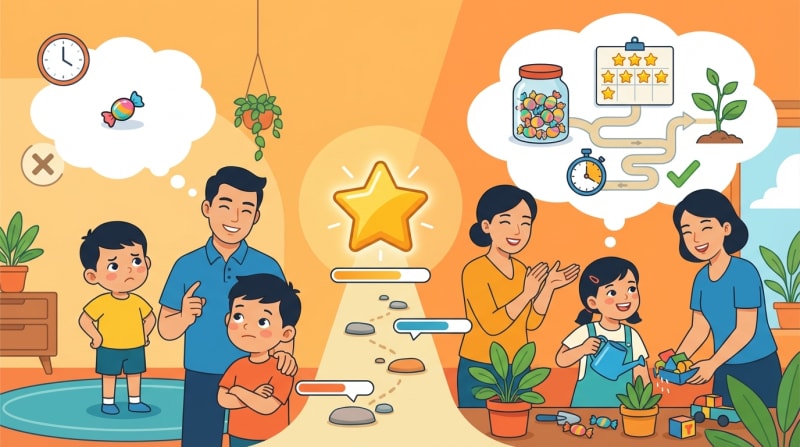
The Secret to Teaching Your Child Patience from the "Marshmallow Test"
In the journey of parenting, you have surely faced situations where you didn't know whether to laugh or cry: Your child rolling around on the supermarket floor demanding a new toy, or screaming because they can't have candy immediately. The refrain "I want it right now!" seems to be a nightmare for many parents.
However, did you know that the ability to control immediate impulses to wait for a better outcome in the future is one of the most important indicators of a child's future success?
Today's article will take parents back to a classic psychological study – The Marshmallow Test – to better understand the importance of patience and how to apply technology with Tasky Kid to train this "golden" skill for your child.
1. A Classic Lesson from the "Marshmallow Test"
In the 1960s at Stanford University, psychologist Walter Mischel conducted a simple experiment that yielded shocking findings. He invited preschool-aged children into an empty room, placed a delicious marshmallow in front of them, and offered two choices:
- The child could eat that marshmallow immediately.
- If the child agreed to wait for about 15 minutes without eating the marshmallow, they would be rewarded with an extra one (totaling 2 marshmallows).
What was the result? Some children ate it immediately. Some tried to cover their eyes, sing, or wiggle around to forget the temptation and successfully waited.
The interesting part lies in the follow-up research years later. The children who agreed to wait to get 2 marshmallows (the group with the ability to delay gratification) tended to have better academic results, healthier BMIs, better stress management capabilities, and were generally more successful in life as adults.
2. "Delayed Gratification" – A Forgotten Skill in the Digital Age
In psychology, this ability to wait is called "Delayed Gratification." It is the ability to resist an immediate temptation to obtain a larger or more enduring reward in the future.
However, in today's digital age, where everything can be achieved with a single "tap" (watching movies without waiting for ads, food delivered to the door in 30 minutes), children increasingly lack opportunities to practice the skill of waiting.
Why is this difficult for children? Biologically, children's brains are not as fully developed as adults'.
- The Limbic System: Responsible for emotions and instincts, it develops very early, driving children to do what they like immediately.
- The Prefrontal Cortex: The area responsible for logical thinking, planning, and impulse control, is the slowest region to develop (often only fully maturing when a person is past 20).
Therefore, teaching a child to wait is not just about character training; it is also a great workout for the brain, helping their prefrontal cortex develop more strongly.
3. Benefits When Children Learn to Wait
Training your child in the skill of delayed gratification brings immense benefits that go far beyond just being "obedient":
- Increased Focus: The child understands they need to finish homework (a difficult task) before watching TV (the reward).
- Better Financial Management: Children learn to save allowance money to buy a big item instead of spending it all on snacks every day.
- Nurturing Gratitude: When they have to make an effort and wait to get what they want, children will cherish the value of the item and the labor involved.
4. How to Teach This Skill in Practice?
Parents cannot force a child to "be patient" through corporal punishment or scolding. This skill needs to be built through daily habits. Here are some effective methods:
Turn Waiting Time into Fun
Don't let waiting time be "dead time." Teach your child how to distract themselves, for example: singing a song, drawing a picture, or playing a small game while waiting for their turn or waiting for food to be served.
Be a Role Model
Children learn through observation. If parents are often impatient when waiting at red lights or get irritable when the internet is slow, the child will follow suit. Show your child that you are also making an effort to wait to achieve a certain goal (e.g., saving money for a family vacation).
Use Visual Support Tools
Because the concept of the "future" is very abstract for children, parents need to concretize waiting and effort through visuals. This is where Tasky Kid becomes a powerful assistant.
5. Applying Tasky Kid: Turning the "Sweet Candy" into Long-Term Goals
Instead of immediately responding when your child demands toys or a trip to the park, turn those desires into Rewards in the Tasky Kid app.
This is the process of "detoxifying" the habit of immediate demands and building a mindset of effort:
-
Step 1: Set the Goal (The Big Marshmallow): Ask your child what they want. A new Lego set? A movie trip? Put it in the "Rewards" section on Tasky Kid and assign it a worthy value, for example: 50 Stars ⭐.
-
Step 2: Break Down the Effort (The Waiting Process): To get those 50 stars, the child cannot have them immediately. They must "work." Parents set up daily tasks such as:
- Making the bed: 2 stars ⭐
- Studying on time: 3 stars ⭐
- Helping mom wash vegetables: 2 stars ⭐
-
Step 3: Track Progress (Visualizing): Every day, when the child completes tasks and receives stars, they will see their accumulation bar filling up. The feeling of seeing themselves getting closer to the goal will help them feel excited and ready to delay immediate gratification (like being lazy or watching TV) to choose positive actions (doing chores).
-
Step 4: Enjoy the Results: When the child accumulates enough 50 stars and exchanges them for the toy, the feeling of happiness at this moment will be many times greater than simply being bought it immediately. The child will understand: "Ah, my waiting and effort have been worthily rewarded."
Conclusion
Teaching children to wait in a hurried world is a challenge, but it is the most precious gift parents can equip for their child's future.
Don't hesitate to start with the smallest things. Let the "sweet candies" be delayed a little, so your child's will and resilience can take a big step forward.
Let Tasky Kid accompany you in establishing a scientific reward system, helping your child learn patience and understand the value of labor starting today!
👉 Are you ready to train the "superpower" of patience for your child? Download the Tasky Kid app now and start this interesting journey at: https://taskykid.com
#TaskyKid #TaskManagementApp #TeachingPatience #DelayedGratification #ScientificParenting
🌟 Tasky Kid jetzt holen
Helfen Sie Ihrem Kind, mit einer Aufgabenmanagement-App gute Gewohnheiten zu entwickeln!
Kostenlos herunterladen