The Secret to Curing iPad "Addiction" and Getting Kids to Do Chores Voluntarily
"Mom, just 5 more minutes, please!"
This is perhaps a phrase so familiar it haunts many modern families. Have you ever come home from work exhausted, only to find that your first task isn't resting, but diving into a "battle" to reclaim the phone or iPad from your child's hands? The screaming, the crying, the tantrums, and the parents' helplessness seem to become a script repeated every single evening.
Ms. Trang, mother of 8-year-old Bin, used to be in that exact situation. But now, instead of arguments, her home is filled with laughter and proactivity. Her journey from the "iPad War" to training a diligent "Star-Hunting Warrior" is an interesting lesson in the art of parenting in the 4.0 era that Tasky Kid wants to share with parents.
1. When Sweet Talk and the Rod Both "Fail"
Bin is a smart boy but extremely addicted to games. The iPad was like an inseparable object, and every request from his mother—like taking a bath, putting away toys, or sitting at his desk—fell on deaf ears.
"My house always looked like a battlefield," Trang recalls. "I tried everything. Gentle persuasion resulted in him just humming along to ignore me. Strictly confiscating the device led to screaming, stomping, and even skipping meals in protest. The result was that I was stressed to the point of insomnia, and my son became increasingly stubborn."
The core issue Trang realized was: Scolding only creates resistance. Children, especially at elementary school age, are often attracted to excitement and instant rewards—something games do very well, while housework is tedious and feels forced.
2. Changing Mindsets: Turning Chores into a "Level-Up Game"
Instead of continuing down a dead-end path with traditional educational methods, Trang decided to test a completely new approach: Gamification of daily activities.
She turned to the Tasky Kid app as an impartial "referee." The idea was simple: If her son likes playing games, turn real life into a game where he is the main character who must perform missions to level up and receive gifts.
Setting Clear Rules
Trang no longer gave verbal orders. Everything was concretized on the app:
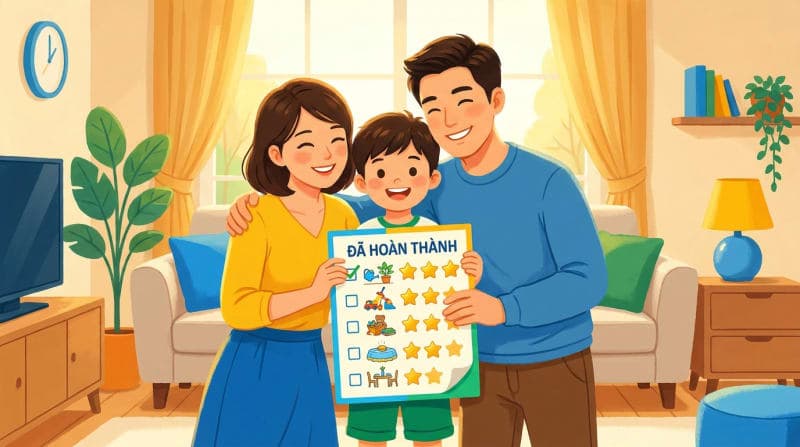
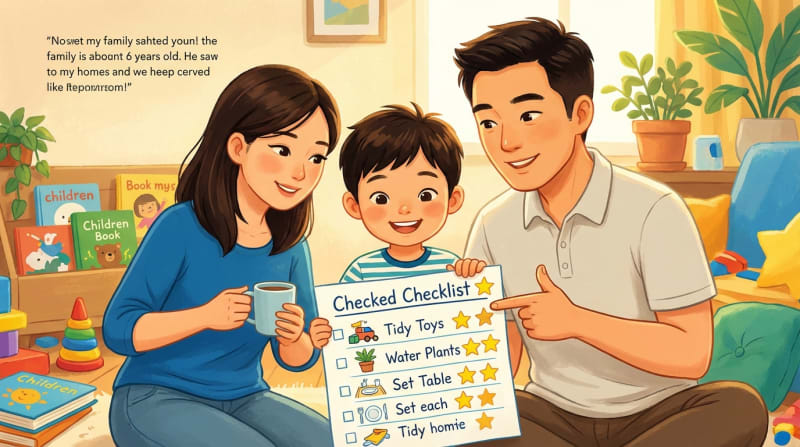
- Voluntarily folding blankets: +2 stars ⭐
- Tidying up toys neatly: +3 stars ⭐
- Finishing homework before 8 PM: +5 stars ⭐
- Voluntarily brushing teeth and washing face: +2 stars ⭐
The most important thing is transparency. The child clearly sees what needs to be done to achieve the goal, rather than feeling like he is being bossed around by his mother.
3. The Power of the "Reward Store": Teaching Kids the Value of Labor
The breakthrough in Trang's method lies in the Redeem Gifts feature on Tasky Kid. She set a strict but attractive rule: There is no such thing as a free lunch.
- Want 30 minutes of iPad time? You need 50 stars.
- Want to buy a new Lego set? You need to accumulate 200 stars.
This is a beginner's lesson in finance and the value of labor. Bin understands that entertainment time is a "privilege" to be traded for effort, not something to be taken for granted.
"The results were surprising! Bin no longer sees housework as a punishment," Trang excitedly shared. "Now, when he wakes up in the morning, he automatically opens the app on the tablet (child mode) to see what missions are available today. The feeling of accumulating each star makes him as excited as when he is 'grinding' in a game."
4. Positive Changes Beyond Expectations
After a month of applying Tasky Kid, Bin's transformation didn't stop at just a tidy house.
Proactivity and Responsibility
One day, Bin checked and saw he was 5 stars short of redeeming a weekend movie ticket. Instead of begging or whining like before, the boy ran to the kitchen: "Mom, the kitchen is dirty, let me clean it for you! How many stars is this mission worth, Mom?"
That innocent sentence proved that he had formed a mindset of proactively looking for solutions to achieve goals, instead of passively waiting.
Family Bonding
The atmosphere in Trang's house has changed completely. The shouting has disappeared. Instead, there are happy discussions: "You did great today, here are some bonus stars!" or "Come on son, you almost have enough points to redeem your gift." Mom has become a companion and guide instead of a grumpy "sheriff."
5. Advice for Parents When Applying the "Star Hunting" Method
Ms. Trang's story is proof that technology, if used correctly, can be a powerful assistant in parenting. Here are 3 secrets for parents to successfully apply this model with Tasky Kid:
- Start with small tasks: Don't set too many difficult tasks at the beginning. Let children taste the feeling of victory with simple tasks like drinking water or putting away shoes.
- Be consistent with rules: If the child doesn't have enough stars, absolutely do not "break the rules" and let them redeem the gift. Consistency helps children understand and respect the rules of the game.
- Diverse rewards: Besides iPads or toys, include spiritual rewards like "Ticket to the park with parents" or "Right to choose dinner." This helps children avoid becoming materialistic and strengthens family bonds.
Conclusion
Parenting is a long journey that requires a lot of patience, but it doesn't have to be a stressful war. By understanding child psychology and applying modern educational methods, we can completely transform children "addicted" to electronic devices into self-disciplined, understanding, and responsible kids.
Thank you, Ms. Trang, for trusting and choosing Tasky Kid as a companion to make motherhood "stress-free."
Do you want to turn housework into joy and help your child detox from the iPad like Bin's family? Start the journey of change today!
👉 Download the app and try it for free at: https://taskykid.com
🌟 Tasky Kid jetzt holen
Helfen Sie Ihrem Kind, mit einer Aufgabenmanagement-App gute Gewohnheiten zu entwickeln!
Kostenlos herunterladen