📖 StoryThursday, January 01, 2026|698 Ansichten
⭐
Laden...
Einen Augenblick!
Einen Augenblick!

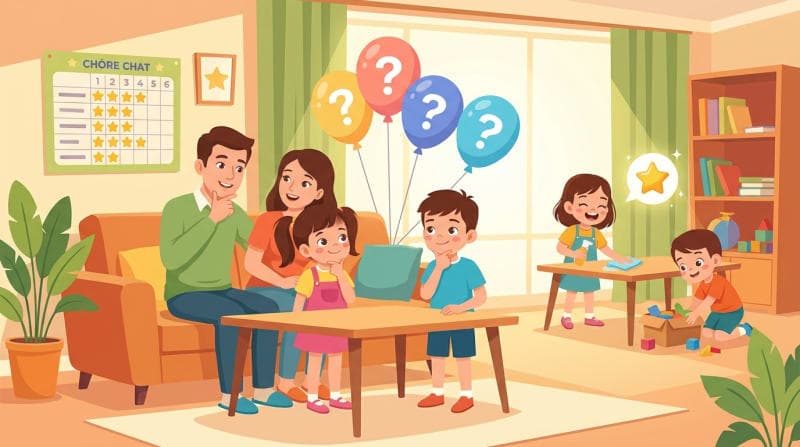
"Mom, why do I have to wash the dishes while he only has to wipe the table? It's so unfair!"
Does this phrase sound familiar to you? If your family has two or more children, you have undoubtedly suffered through a "cold war" or heated arguments between siblings at least once, simply over the division of housework.
Ms. Lan, a mother of two boys (ages 8 and 11), used to fall into a state of extreme stress because she had to play "judge" every single day. The scene of two brothers bickering, comparing who did more, or arguing about who Mom spoiled more made the family atmosphere constantly tense.
However, everything changed completely thanks to a new management method. This article will share the journey from "battlefield" to "peace" in Ms. Lan's family and how you can apply it today so your children become more self-disciplined and loving toward each other.
Before finding a solution, we need to understand child psychology. This rivalry doesn't necessarily stem from laziness, but deeper down, it is a need for fairness.
Between the ages of 6 and 12, children begin to form a strong sense of "self" and equality. However, a child's ability to assess workload is not yet fully developed. In the eyes of Ms. Lan's youngest son, the act of "washing a basin of dishes" and "wiping a table" seemed similar in terms of action, but he felt washing dishes was "dirtier" and "took longer," leading to a feeling of being treated unfairly.
When parents give general verbal commands like: "You two clean the house," children will immediately compare to see who is doing less so they can... do less to match.
Most parents, upon seeing their children arguing, choose to intervene immediately:
This solution is only temporary. In the long run, it creates a dependency mindset for the younger child and a sense of frustration for the older one. Mom is exhausted, and the children still haven't learned how to share responsibility. This was the deadlock Ms. Lan faced for a long time.
Ms. Lan's decision to change her educational method began when she sought the help of technology: The Tasky Kid App. Instead of verbal commands, she started "digitizing" all household chores.
The secret lies in Transparency and Value Exchange.
On Tasky Kid, each task is no longer a dry command but comes with a specific value:
When everything is displayed clearly on the phone/tablet screen, arguments about qualitative nature ("this job is harder than that job") disappear. Numbers don't lie, and children trust specific numbers.
Each child has their own account on the app. Everyone worries about their own To-do list. The younger brother no longer has a reason to look at his older brother and say, "He's playing," because if his own task isn't finished, his star count won't increase.
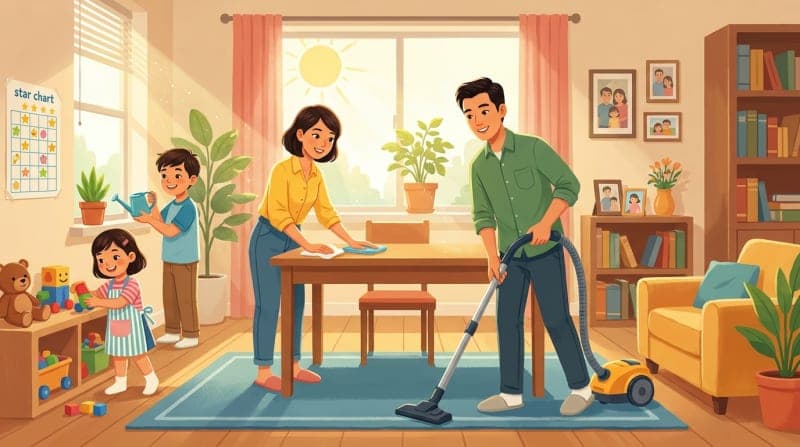
After applying Tasky Kid, Ms. Lan's family witnessed a spectacular transformation.
No one complains about unfairness anymore because the exchange of effort is very fair. If the younger brother wants as many stars as the older one, he is forced to take on "tougher" jobs or do a larger quantity. The children's mindset shifted from "Comparing and envying" to "Optimizing effort."
The best part of this method is the reward mechanism. Ms. Lan set up a "Reward Store" right on the app:
The two brothers started racing to take on more work to accumulate stars. Instead of pushing work away, the kids proactively asked: "Mom, are there any chores left today to earn stars?" This is something Ms. Lan had never dared to dream of before.
To achieve success like Ms. Lan's family, parents should note the following points when using Tasky Kid:
Housework is not just about sharing the burden with parents; it is also the first lesson in responsibility, fairness, and time management skills for children. Don't let arguments chip away at sibling affection or make the family atmosphere heavy.
Be like Ms. Lan, become a wise mother who knows how to "leverage" tools to make parenting lighter. When rules are transparent and rewards are worthy, jealousy will automatically disappear, giving way to joy and self-discipline.
Parents who are headache-stricken because their children constantly bicker must try this method!
👉 Download the app and experience it for free to "set yourself free" at: https://taskykid.com
Helfen Sie Ihrem Kind, mit einer Aufgabenmanagement-App gute Gewohnheiten zu entwickeln!
Kostenlos herunterladen