"Mom, Don't Buy It": The Secret to Helping Kids Understand the Value of Hard Work
When a child's words shift an entire educational mindset
"Mom, don't buy it for me, let me 'earn' it myself!"
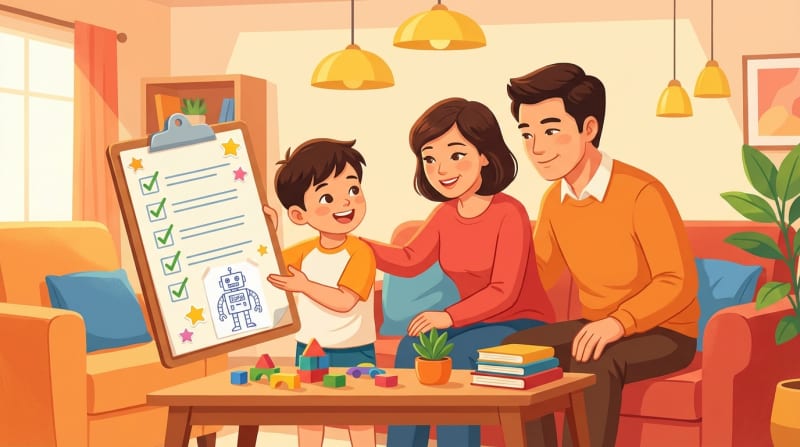
This isn't a line from an educational movie; it’s the sentence that left Ms. Lan Anh (Da Nang) stunned just as she was about to pull out her wallet to buy a new robot kit for little Bo (8 years old). Just a few months ago, this scenario would have played out very differently: Bo would have been crying and throwing a tantrum in the middle of the supermarket if his mom refused to buy the toy he liked.
So, what transformed a demanding little boy into such a sensible child who cherishes the value of labor? The answer lies in a bold shift in the family's educational method: Moving from "giving for free" to "working to achieve."
This article shares the inspiring story of Bo and his mom, along with secrets to help parents teach their children about finances and patience from a young age.
A Common Headache for Modern Parents: "I Want It, I Get It"
Ms. Lan Anh shares: "Before, whenever we went to the supermarket or he saw a cool toy online, Bo would pester me for it. If I didn't buy it, there was guaranteed to be a scene with crying and whining all afternoon. It gave me such a headache because I was afraid he would become spoiled and not know how to value money."
This is a common reality for many families today. Out of love and a desire to give their children the best, many parents unintentionally create a habit of "passive entitlement." Children assume that receiving toys and nice clothes is their parents' responsibility and their obvious right.
The consequence is that children lack:
- Patience: They want everything immediately.
- Gratitude: They take their parents' hard work for granted.
- Goal Management Skills: They don't know how to plan to achieve what they want.
The "Earn It Yourself" Revolution with Tasky Kid
Realizing the danger of unconditional pampering, Ms. Lan Anh decided to change the "rules of the game" at home by applying technology to child education. She used Tasky Kid—a chore management app for children—as a tool to establish soft discipline.
Instead of forbidding him (causing frustration) or buying it immediately (causing dependence), she set the robot kit as a reward on the app with a "price" of 300 stars.
1. Fair Rules
To get his dream gift, Bo had to complete specific daily tasks such as:
- Tidying up his study corner (2 stars).
- Watering plants every afternoon (3 stars).
- Going to bed on time voluntarily, without reminders (5 stars).
2. A Magical Psychological Shift
"Unexpectedly, instead of whining, the little guy threw himself into 'grinding' tasks with immense enthusiasm," Ms. Lan Anh recounted excitedly.
Every time a good deed was completed, the "ding" sound of adding stars on the Tasky Kid app rang out like a word of encouragement, making Bo feel his achievements were recognized immediately. The feeling of watching his accumulated stars increase every day was far more interesting than crying to demand gifts.
3. A Lesson on the Value of the Gift
The day Bo accumulated enough 300 stars to exchange for the robot, his attitude was what moved Ms. Lan Anh the most. He cherished that toy far more than usual. No throwing it around carelessly; he put it away neatly after playing. To Bo, it wasn't just a gift mom bought; it was the fruit of his own labor after days of effort.
Why is this method more effective than preaching?
Explaining that "Money is hard to earn" or "You have to be good to get gifts" often goes in one ear and out the other because it's too abstract for kids. Conversely, Gamification of daily tasks brings practical impact:
- Visualizing Goals: Children clearly see the gift they want and the distance (number of stars) they need to cover.
- Creating Intrinsic Motivation: Children do chores because they want to achieve their own goals, not because they are afraid of being scolded.
- Primary Financial Literacy: Children understand the rule "Work = Value = Reward." This is a crucial introductory lesson in financial management.
3 Steps for Parents to Apply Immediately
Do you want your child to be self-disciplined and sensible like Bo? Try applying this simple 3-step process with the support of Tasky Kid:
- Agree on Goals (Wishlist): Sit down with your child and ask what item they are craving (a toy, comic books, a movie trip...). Put that item in the "Gift Store" within the app.
- Valuation and Assignment: Convert the gift into a corresponding number of stars. Then, set up age-appropriate chores (folding blankets, washing dishes, wiping tables...).
- Consistency and Encouragement: When your child does well, approve the task and add stars immediately to encourage them. When your child is lazy, do not do it for them; let them understand that without work, the goal remains out of reach.
Conclusion
Bo's story is the clearest proof that children are not afraid of work; they just need the right motivation and an interesting method.
Tasky Kid not only helps parents manage chores and free up labor for adults, but more importantly, the app helps sow the seeds of precious qualities: independence, responsibility, and gratitude.
Don't let toys bring only short-term joy. Let the journey to achieve that item become a lesson that stays with your child for a lifetime.
👉 Are you ready to change habits for your child? Download the app and set up a challenge now at: https://taskykid.com
🌟 Tasky Kid jetzt holen
Helfen Sie Ihrem Kind, mit einer Aufgabenmanagement-App gute Gewohnheiten zu entwickeln!
Kostenlos herunterladen